When temperatures drop, your rifle's accuracy can shift. Cold air is denser, increasing bullet drag, while frigid conditions slow gunpowder burn rates, reducing muzzle velocity. Together, these effects cause bullets to hit lower and drift more, especially at long distances. For example, at 400 yards, a bullet may drop 2.5 inches more and drift nearly 5 inches further at 0°F compared to 90°F.
To maintain accuracy during winter hunts: (like those offered for Kentucky whitetail hunting)
- Re-zero your rifle in cold conditions.
- Use temperature-stable ammunition (e.g., Hodgdon's Varget or IMR Enduron).
- Keep cartridges warm to prevent velocity loss.
- Limit shots to under 300 yards when possible.
Understanding these factors and preparing accordingly ensures your shots stay precise, even in freezing weather.
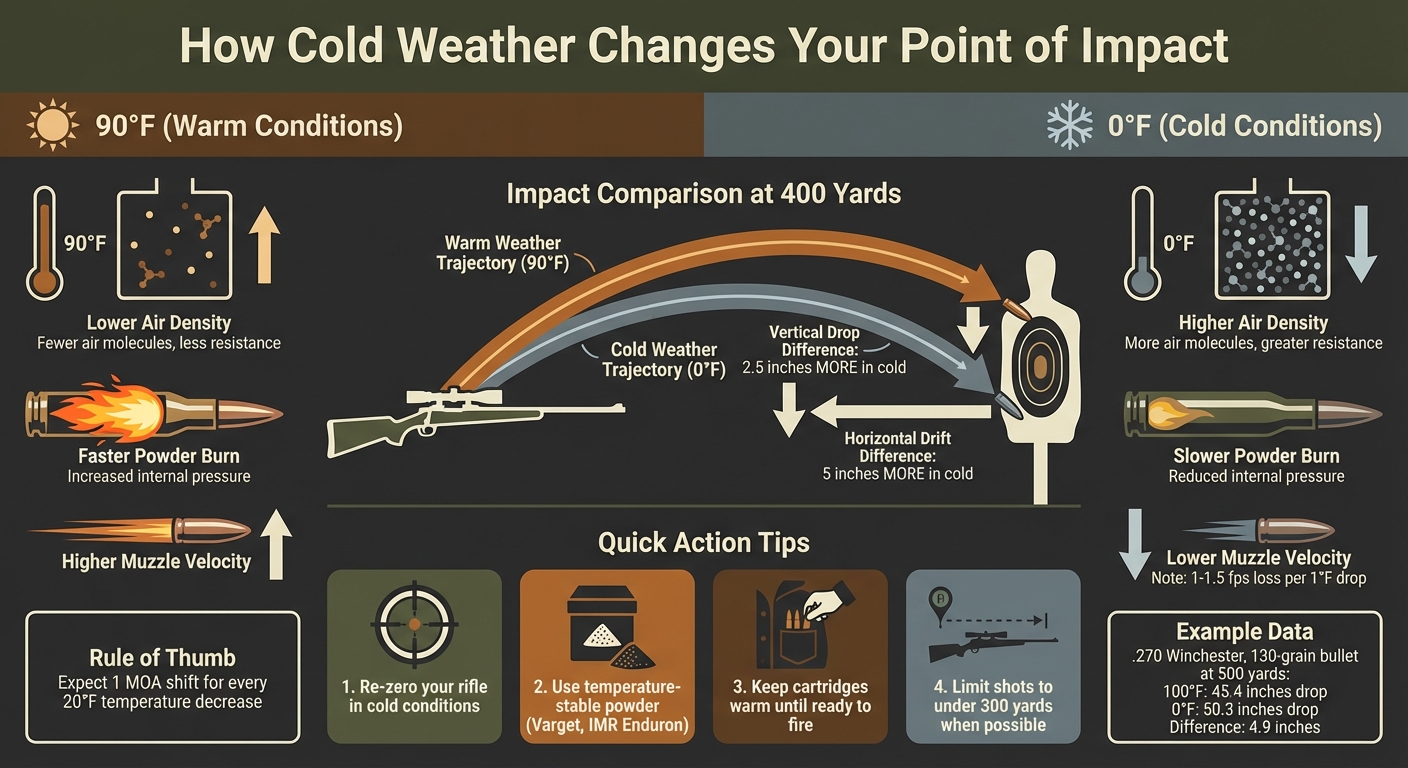
Temperature Impact on Bullet Trajectory: 90°F vs 0°F Comparison
How Cold Air Density Changes Bullet Flight
Air Density and Drag Explained
In January, Kentucky's cold air becomes denser and more resistant to objects moving through it. This happens because cold air molecules are packed closer together than in warm air. For context, under standard conditions (59°F and sea-level pressure), a cubic foot of air weighs 0.0807 pounds. As temperatures drop, that same volume of air becomes heavier and thicker.
This denser air increases aerodynamic drag, much like moving through syrup instead of water. A bullet traveling through this thicker air faces greater resistance, which saps its kinetic energy and slows it down. The slower the bullet travels, the more time gravity has to pull it downward, increasing its drop before it reaches the target.
For example, a .270 Winchester firing a 130-grain bullet drops 45.4 inches at 500 yards in 100°F conditions. At 0°F, that drop increases to 50.3 inches - nearly 5 inches more. Similarly, a .22-250 Rem sees about 1.5 inches of additional drop at 400 yards when the temperature shifts from 90°F to 0°F. Cold air also amplifies wind drift, potentially pushing bullets up to 4 inches farther off course at long distances.
These changes in bullet trajectory mean hunters in Kentucky must make careful adjustments when taking longer shots in cold weather.
What This Means for Kentucky Hunters
For hunters in Kentucky, January’s cold air can have a noticeable effect on shot placement, especially at distances beyond 300 yards. As temperatures drop, the point of impact shifts lower. A good rule of thumb is to expect about a 1 MOA shift for every 20°F decrease from the temperature at which you zeroed your rifle.
However, these adjustments aren’t one-size-fits-all. The exact shift depends on your specific ammunition and rifle setup. To ensure accuracy, recheck your zero under actual winter conditions instead of relying on data collected in warmer months. Using bullets with high ballistic coefficients can help reduce drag, but limiting shots to shorter ranges when possible is often the best way to maintain precision. These factors tie directly into the scope re-zeroing and shooting techniques discussed in related sections.
How Temperature Affects Powder Burn and Velocity
Why Powder Burns Slower in Cold Weather
When temperatures drop, the chemical reaction that ignites smokeless gunpowder slows down, resulting in a slower powder burn. This reduced burn rate lowers chamber pressure, which, in turn, decreases muzzle velocity. On average, you can expect a loss of about 1–1.5 feet per second (fps) in muzzle velocity for every 1°F drop in temperature.
For instance, Norma conducted tests in December 2023 using a .30-06 Jaktmatch cartridge. At 70°F, the cartridge clocked an average velocity of 2,625 fps. However, as the temperature dropped to 28.4°F, the velocity fell to 2,575 fps - a 50 fps drop. At -0.4°F, it dropped further to 2,533 fps, marking a total loss of 92 fps.
Ballistician Ron Spomer’s findings align with this pattern. Testing a .22-250 Rem load with a 55-grain bullet, he observed a drop in muzzle velocity from 3,700 fps at 90°F to about 3,572 fps at 0°F. This reduction in velocity not only affects speed but also amplifies trajectory drop and wind drift, emphasizing the need to adjust for cold-weather shooting conditions.
Selecting Cold-Weather Ammunition
To counteract these velocity losses, it’s essential to choose ammunition designed for cold weather. Not all ammunition performs equally in freezing temperatures, but those loaded with temperature-stable powders are specifically formulated to burn consistently, no matter the conditions. For reliable performance, consider loads featuring powders from Hodgdon’s "Extreme" line, like Varget and H-1000, or IMR’s "Enduron" series.
Keeping your ammunition warm is another critical factor. Storing spare cartridges or magazines in an internal jacket pocket can help maintain powder temperature, preventing the significant velocity drops caused by exposure to freezing conditions. Only chamber a round when you’re ready to fire, as a warm cartridge left in a cold chamber will quickly lose heat. Additionally, avoid over-lubricating your firearm, as cold temperatures can cause oils to thicken and hinder performance.
Adjusting Your Scope for Cold Weather
Re-Zeroing Your Rifle in January
A zero set during summer won’t cut it when January’s chill sets in. The colder air - being denser - along with a slower powder burn that reduces muzzle velocity, can cause your bullet to hit lower, especially beyond 200 yards. According to Army guidelines, you can expect a 1-inch drop per 100 yards for every 20°F temperature decrease.
Before heading to the range, let your rifle and ammunition acclimate to the cold for about 30 minutes. This ensures your adjustments reflect the actual conditions you'll face. Forensic firearm expert Al Voth emphasizes the importance of temperature-specific zeroing:
"Whenever possible, zero any rifle at or near the temperature where it will be used. I've found that bullet velocities usually drop, groups open up, and slight changes in zero, both vertically and laterally, occur when temperatures plummet".
Start by firing a three-shot group at 100 yards to check for any shifts in your primary zero caused by the cold, such as thermal contraction of scope rings or mounting hardware. Afterward, test your drop at longer distances, like 300 or 400 yards, and record these cold-weather impacts. This data will be far more reliable than using summer figures. This precision is vital when preparing for ultimate whitetail hunts in Kentucky where environmental factors vary. Once you’ve locked in your zero, fine-tune your adjustments with ballistic calculations.
Using Ballistic Calculators
To get even more precise, use a ballistic calculator with real-time range data. Tools like the Hornady 4DOF, Federal Premium Ballistics Calculator, or apps such as "Ballistic" can help you predict how cold weather will affect your trajectory. Precision rifle instructor Ted Hoeger explains:
"The intended purpose of a ballistic program is to adjust our shooting solution for the changing atmospherics and location at which we are shooting".
Use a handheld meter, like a Kestrel, to measure your environmental conditions. Input this data into your ballistic calculator, then compare the predicted drop with your actual impacts at 300 or 400 yards. If there’s a discrepancy, adjust the muzzle velocity in the calculator until its predictions align with what you’re seeing on target.
sbb-itb-e01ab49
Winter Shooting Tips for Kentucky Hunters
Keeping Ammunition Warm
To ensure your ammunition performs consistently, it’s crucial to keep it warm. When cartridges get cold, the powder burns slower, reducing bullet velocity and causing shots to hit lower at long distances.
The best way to prevent this is by keeping your rounds close to your body. Store them in an internal jacket pocket where your body heat can maintain a steady temperature. Insulated ammunition pouches are another solid option. Avoid leaving your cartridges in a cold truck overnight or attaching them to an external belt loop, as prolonged exposure to the cold can affect their performance. If possible, opt for factory ammunition made with temperature-resistant powders like Hodgdon's Varget, H-1000, or IMR Enduron. These powders are designed to deliver consistent burn rates, even in freezing conditions.
In addition to managing ammunition temperature, positioning yourself for shorter shots can help minimize the effects of cold weather on your accuracy.
Using Kentucky Terrain to Get Closer
Reducing the distance to your target is one of the most effective ways to counteract cold-weather ballistic changes. Kentucky’s diverse landscape - rolling hills, creek bottoms, and hardwood ridges - offers plenty of natural cover to help you close in on your target. When you’re shooting at ranges under 200 to 300 yards, the impact of temperature on your bullet’s trajectory becomes almost negligible.
Outdoor writer Ron Spomer explains it well:
"Perhaps the best news of all is that you rarely need to shoot beyond 300 yards when winter predator hunting... Then cold induced trajectory differences mean nothing!"
Use features like ridgelines and hollows to carefully stalk within an ethical shooting range, ideally under 300 yards. Before heading out, scout your stand locations with a rangefinder and mark distances to key landmarks - such as treelines, rock formations, or fence posts. Combining smart terrain use with proper ammunition care ensures your shots remain accurate and ethical, even in the coldest conditions.
Cold weather and its effects on ammunition | Norma Academy
Conclusion
January's chill can change how your rifle performs. The denser winter air increases drag on the bullet, and cold powder burns more slowly, lowering the bullet's point of impact compared to warmer months. As Ron Spomer explains:
"Heat rises and so does bullet impact. Cold sinks and so does bullet impact".
While the effects are minor within 200–300 yards, they become more noticeable at longer distances. For example, at 400 yards, a bullet fired at 0°F may drop 2.5 inches more and drift nearly 5 inches further compared to one fired at 90°F.
To stay accurate, reconfirm your zero for winter conditions. A rifle zeroed in August won't perform the same in January. Opt for temperature-stable ammunition, keep your cartridges warm until you're ready to fire, and use Kentucky's natural cover to limit your shooting range. These adjustments will help you maintain precision and consistency during winter hunts.
FAQs
How does cold weather impact bullet trajectory and accuracy?
Cold weather has a noticeable impact on bullet trajectory, primarily because colder air is denser. This increased density creates more drag on the bullet, slowing it down and causing it to drop more significantly over long distances. For instance, at 300 yards, the bullet may drop several extra inches, and the effect becomes even more pronounced at 500 yards or farther. Denser air also intensifies the influence of crosswinds, resulting in greater sideways drift.
Extreme cold, such as temperatures around 0°F, can also affect the performance of your firearm. Gunpowder may burn less efficiently in such conditions, potentially lowering muzzle velocity or, in rare cases, even leading to misfires. On top of that, cold weather can challenge the shooter - numb fingers can reduce trigger control, and thicker lubricants in the firearm may increase friction, affecting its action. All of these factors can push your point of impact lower and diminish accuracy unless adjustments are made to account for the temperature shift.
How can I adjust my rifle for accurate shooting in cold winter weather?
Cold weather can throw off your rifle's accuracy, but with a few tweaks, you can stay on target. Start by ensuring your rifle is clean, dry, and lubricated with oil rated for low temperatures. This helps prevent freezing or rust, which could impact performance. Before heading out, re-zero your scope - colder, denser air can cause bullets to hit lower than expected. As a general guideline, expect your shot to land about 1 inch lower per 100 yards for every 20°F drop in temperature.
To keep your rifle performing consistently, consider using ammunition specifically designed for cold weather or those with powders that perform well in low temperatures. Let your rifle adjust to the cold before firing, and keep your ammo insulated to avoid temperature fluctuations that might affect velocity. With these adjustments, you'll be better prepared for accurate shooting during those chilly Kentucky winter hunts.
What type of ammunition works best in freezing temperatures?
When you're dealing with freezing conditions, factory-loaded ammunition is the go-to choice for dependable performance. Specifically, seek out rounds that use temperature-stable smokeless powders. These powders are engineered to deliver consistent results, even when the mercury dips below freezing.
This means your shots will stay accurate, no matter how cold it gets, helping you maintain precision and adjust your aim effectively during those frosty winter hunts.