If your field points group well but your fixed-blade broadheads hit somewhere else, your bow is not as tuned as it looks. In most cases, broadheads miss for three plain reasons: more drag, more planing, and more sensitivity to small setup errors.
Here’s the short version:
- Field points are more forgiving
- Fixed-blade broadheads magnify small tune problems
- At 40 yards, broadheads and field points can land within 2–3 inches if the setup is right
- In a light crosswind at 50 yards, broadheads may drift 1–2 inches more than field points
- A tight broadhead group matters more than perfect overlap with field points
- If broadheads group off to one side, I’d check rest position, nock height, cam timing/lean, and arrow spine
- If broadheads scatter, I’d check arrow straightness, insert alignment, and broadhead spin
For me, the main takeaway is simple: broadheads are a tuning test. They show problems that field points can hide. That means I don’t judge my setup by field-point groups alone. I want broadheads to group well at 20, 30, and 40 yards, because that tells me more about what will happen on a whitetail hunt.
You Should NEVER Have to TUNE FIXED BLADE BROADHEADS!
Quick Comparison
| Flight factor | Field points | Fixed-blade broadheads |
|---|---|---|
| Drag | Low | Higher |
| Planing | Very low | Higher |
| Wind drift | Lower | About 1–2 inches more at 50 yards |
| Reaction to tune issues | Can hide them | Shows them fast |
| Best thing to judge | Tight groups | Tight groups, then point of impact |
So when I look at broadhead flight, I’m not chasing perfection. I’m looking for repeatable impact, small rest changes, and arrows that spin true. That’s what gives me a setup I can trust.
Fixed-Blade Broadheads vs. Field Points: Key Flight Differences
The biggest gap between fixed-blade broadheads and field points shows up in drag and planing. Fixed blades sit at the front of the arrow and act a bit like tiny steering fins. Because of that, small launch mistakes matter a lot more once the arrow leaves the bow.
Drag, Drop, and Planing
Planing is the main problem. If an arrow leaves the bow with even a slight angle, the blades catch air and push the front of the arrow farther in that same direction. As the arrow keeps flying, that push builds. So a tiny error at launch can turn into a miss of several inches at longer distance.
Broadhead-tipped arrows have also been observed to drift 1–2 inches more than field points in a light crosswind at 50 yards. On the target, that usually shows up in one of two ways: a steady offset or a scattered group.
| Flight Factor | Field Points | Fixed-Blade Broadheads |
|---|---|---|
| Drag | Minimal | Significantly higher |
| Wind Drift | Low | 1–2" more at 50 yards |
| Sensitivity to Tune | Low; hides minor errors | High; magnifies every flaw |
| Grouping Forgiveness | High | Low; punishes torque and poor release |
Grouping Patterns and Common Miss Directions
A tight, steady offset usually points to one clear fix. Scattered impacts usually point to more than one issue. If arrows land left or right, or high or low, in a repeatable way, that often means a tune problem. If impacts are spread out, the cause is more likely an arrow issue or an uneven release.
A few miss patterns tend to repeat:
- Broadheads hitting low often suggest a nock-high condition.
- Broadheads hitting left or right of field points usually point to a center-shot issue.
- For a right-handed shooter, broadheads landing left of field points often mean the rest needs to move right.
- Groups that stay scattered after changes often suggest arrows that do not spin true or a spine that is too weak for the bow’s draw weight.
Those miss patterns help narrow down what to check first: bow setup, rest position, or the arrows themselves.
How to Get Fixed-Blade Broadheads to Hit With Field Points
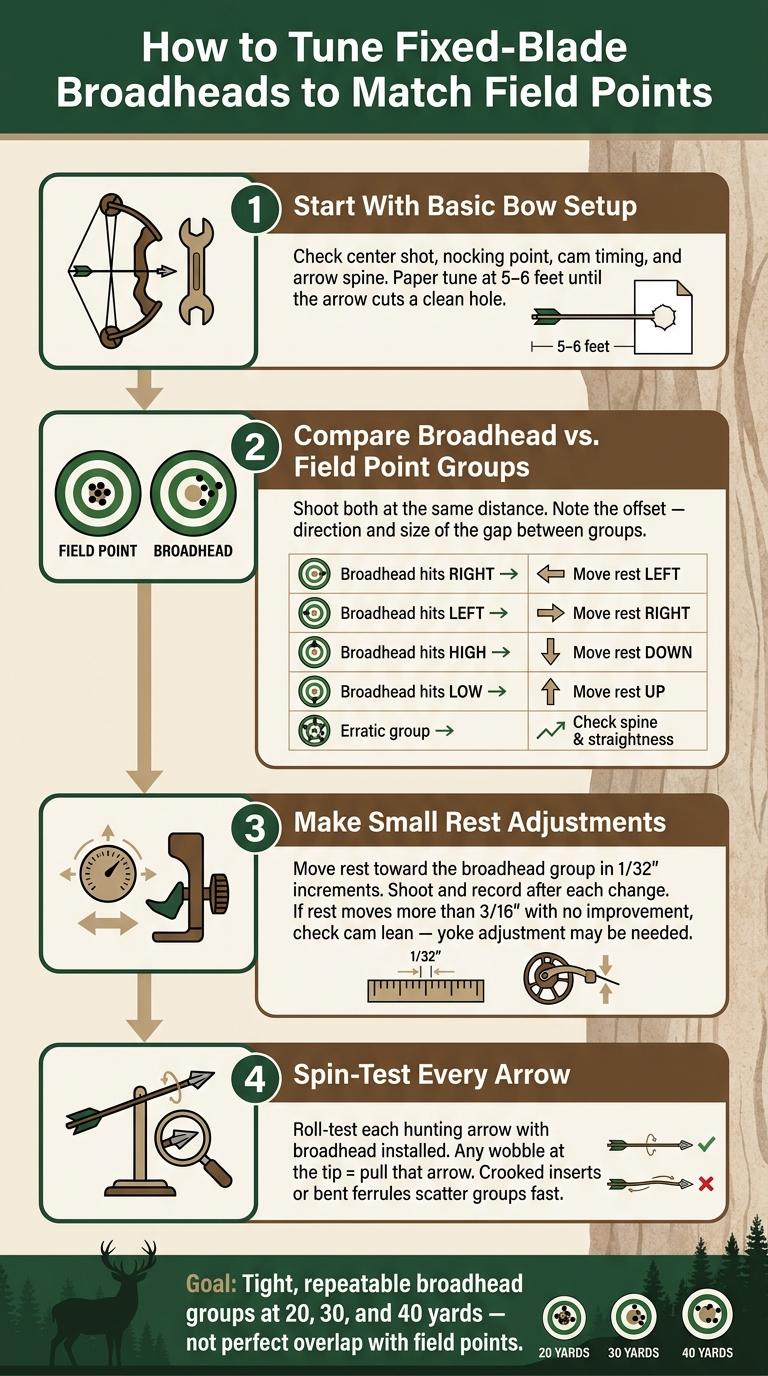
How to Tune Fixed-Blade Broadheads to Match Field Points
Getting fixed-blade broadheads to hit with your field points is a process. It usually isn’t one magic tweak. First, figure out how the broadheads are missing. Then fix things in the right order.
Start With Basic Bow and Arrow Setup
If your base setup is off, rest changes usually won’t solve broadhead flight.
For compound bows, check center shot, nocking point, cam timing, and arrow spine. For crossbows, cam synchronization is the crossbow version of this check. After that, paper tune at 5 to 6 feet until the arrow cuts a clean hole. That’s the point where broadhead tuning starts to mean something.
Make Small Rest Adjustments and Retest
Shoot both groups at the same distance, then compare them. From there, move the rest toward the broadhead group. The idea is simple: note the offset, make a small correction, and bring the broadhead group back toward the field-point group.
| Broadhead Impact (vs. Field Point) | Rest Adjustment | Next Check |
|---|---|---|
| Hits right | Move rest left | Check cam lean or yoke tuning |
| Hits left | Move rest right | Check cam lean or yoke tuning |
| Hits high | Move rest down | Check arrow clearance |
| Hits low | Move rest up | Check for fletching contact |
| Erratic, no group | Check spine and straightness |
Keep the moves small – about 1/32 inch at a time. Shoot again after each change, and write down what happened before changing anything else.
If you’ve moved the rest more than 3/16 inch left or right and the groups still won’t come together, there’s a good chance the issue is cam lean. At that point, more rest movement usually just wastes arrows. You’ll need a yoke adjustment instead.
If rest changes stop making things better, shift your attention to arrow and broadhead straightness.
Check Arrow and Broadhead Straightness
If the group is still all over the place, test the arrow itself.
Roll-test every hunting arrow with the broadhead installed on a flat surface or with arrow rollers. If you see any wobble at the tip, even a small one, the insert, ferrule, or shaft is out of line. That arrow will not group the way you want.
Pull any wobbling shaft from your hunting set. A crooked insert or a bent ferrule can spread broadhead groups fast.
Testing Broadhead Flight for Kentucky Whitetail Hunting
Best Distances and Conditions for Testing
Once the bow is tuned, stop at paper tuning and move to distance testing. This is where you confirm that everything still holds up at the ranges that matter for hunting.
Start at 20 yards, then back up to 30 and 40 yards. Those are common shot distances for Kentucky whitetails, so they’re the right place to test. Shoot in calm weather first, then in light crosswinds. That gives you a better read on whether your broadheads stay steady or start drifting.
If your broadheads keep flying on line in light wind at 40 yards, you can head into the field with a lot more confidence.
That kind of range work shows whether your tune still holds where deer are actually taken.
What Accuracy Looks Like for Northeastern Kentucky Shots
At 40 yards, look at consistency first. Your broadheads should land in a tight, repeatable group. That’s the standard to judge. You don’t need perfect arrow-on-arrow overlap.
Use repeatable broadhead groups as the benchmark at that distance. Fixed-blade broadheads often need a tighter tune than field points, but once the bow is set up right, they can give you strong penetration and steady flight. The target isn’t perfection at 60 yards. It’s clean, ethical accuracy at the distances where Kentucky whitetails usually show up.
Arriving at a Guided Hunt With a Proven Setup
If you’re hunting with a guide, check everything before the trip. If you’re booking an archery or crossbow hunt with Whitetail Hunting Kentucky, finish your broadhead testing before you arrive.
Your arrows, broadheads, and sight marks should already be checked and confirmed at 20, 30, and 40 yards.
Conclusion: Focus on Predictable Broadhead Groups, Not Perfect Point-of-Impact Matching
After tuning and testing, one lesson stands out: fixed-blade broadheads expose tuning flaws because their blades create drag and steering pressure that field points simply don’t.
For hunting, the standard is practical. You want a tight broadhead group, not perfect impact overlap with field points. Don’t burn time chasing exact point-of-impact matching. If your broadheads group tightly but hit away from your field points, sight in to the broadhead group.
That’s the standard for Kentucky whitetail setup work. Your broadhead group tells you if the bow is ready. Careful tuning, arrow spin-testing, and practice at true hunting distances build confidence – and that confidence is what helps you make a clean, ethical shot when a deer steps out.
FAQs
Why do fixed-blade broadheads hit differently than field points?
Fixed-blade broadheads behave differently because their blades catch air almost like vanes. That extra surface area can make small problems with bow tune or shooting form show up FAST.
Field points are more streamlined. Fixed blades, on the other hand, create drag and steering forces. If the arrow doesn’t leave the bow perfectly straight, those forces can cause it to plane off target.
That’s why bow tune matters so much here. A properly tuned bow helps cut down the gap between how field points fly and how fixed-blade broadheads fly.
Should I sight in with my broadheads or my field points?
Sight in with your broadheads, not just field points. Field points are more aerodynamically neutral. Fixed-blade broadheads, on the other hand, can expose small tuning or arrow-flight issues, and they may not hit in the same spot.
It’s a simple but big deal: practice with the exact broadheads you plan to hunt with so you can confirm point of impact.
You can tune your bow to bring broadhead and field point groups closer together. But that doesn’t always make them identical. In some setups, you may still need broadhead-specific sight pins or a custom sight tape, especially at longer distances.
What should I check first if my broadheads won’t group?
First, check your bow’s overall setup. Make sure it matches factory specs, including axle-to-axle length and brace height. Then check center shot, nock height, and wheel or rest timing.
Next, spin-test your broadheads on a flat surface. You’re looking for wobble, which can come from bent inserts or poor alignment. If all of that checks out, arrow spine is often the main cause.