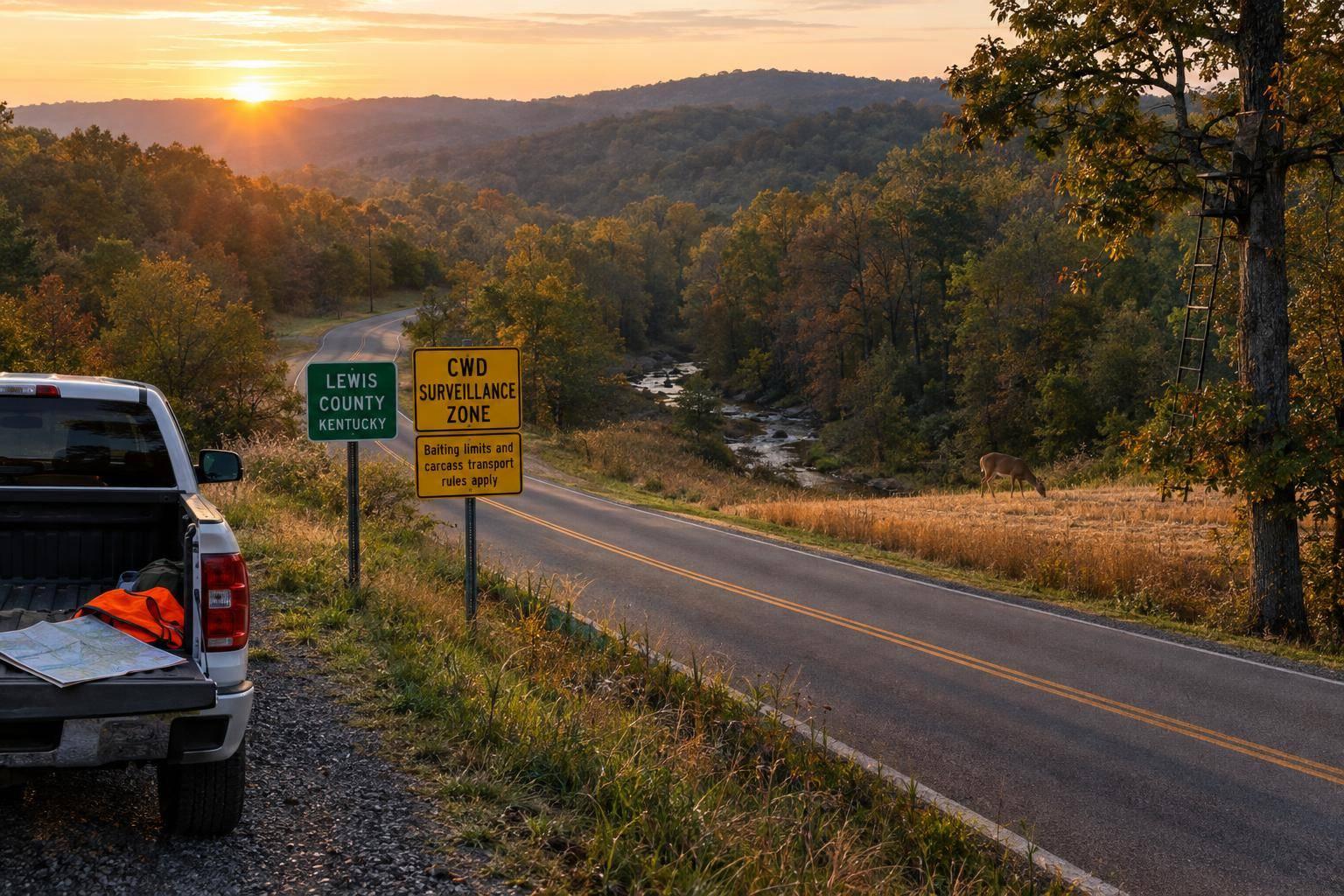
Before you bait or hunt, I recommend checking three things together: the property’s CWD status, the feeder setup, and your route home with a deer. Kentucky’s deer hunting zones and CWD surveillance zones are separate, so check both on current KDFWR guidance.
I’d build your hunt plan around these checks:
- Bait and feeders: Confirm what your land type allows, how feed must be spread, and whether seasonal feeding limits apply.
- Harvest transport: Check which deer parts can leave the harvest area before choosing a processor or planning a return to the lodge.
- Hunt requirements: Verify licenses, dates, reporting deadlines, and any required CWD check-station stops.
For a trip with Whitetail Hunting Kentucky, I’d also confirm hunt support and arrange processing separately. <u>A legal bait setup does not make every carcass route legal.</u>
Special Regulations in CWD Surveillance Zones
Check Baiting and Feeding Rules
Before you put out bait, check the current KDFWR CWD page and 301 KAR 2:015. Save a copy of the rules and the date you checked them.
Rules for Bait, Feeders, and Attractants
Confirm the property type for Ultimate Whitetail Hunts in Kentucky, then check both the feeder and what you plan to put in it. How a feeder works matters more than its brand name. If it gathers deer at one point, check with KDFWR before using it.
| Material or setup | Private land inside a CWD surveillance zone | Outside the zone on private land |
|---|---|---|
| Corn, grain, and other ingestible attractants | Allowed when the current CWD baiting authorization is in effect. Prohibited contact-style feeders remain off-limits. | Follow statewide baiting and seasonal feeding rules. |
| Salt and minerals | Treat these as ingestible attractants. Check current CWD-zone rules before putting them out. | Follow statewide salt, mineral, and seasonal feeding rules. |
| Scattered bait or broadcast feeders | Allowed when feed is scattered rather than delivered into a contact-style container. | Broadcasting does not override statewide feeding restrictions. |
| Troughs, funnels, and gravity feeders without spreading capability | Prohibited contact-style feeders. | Check statewide and property-specific feeder rules. |
Under the cited CWD guidance, scent attractants and deer-urine products remain allowed. You still need the required license, permission to hunt, and compliance with legal hunting dates and bag limits.
Seasonal Feeding Limits and Exceptions
The statewide wildlife-feeding ban runs March 1–July 31, with narrow exceptions for normal agriculture, food plots, hanging bird feeders within a home’s curtilage, and certain furbearer-trapping attractants. Grain, salt, and minerals do not qualify for the trapping exception.
Permission to bait does not mean permission to feed year-round. Scattering feed with a broadcast feeder does not make it normal agriculture, either.
Once you’ve confirmed the bait site is legal, check which deer parts can leave the zone.
Check Carcass Movement Restrictions
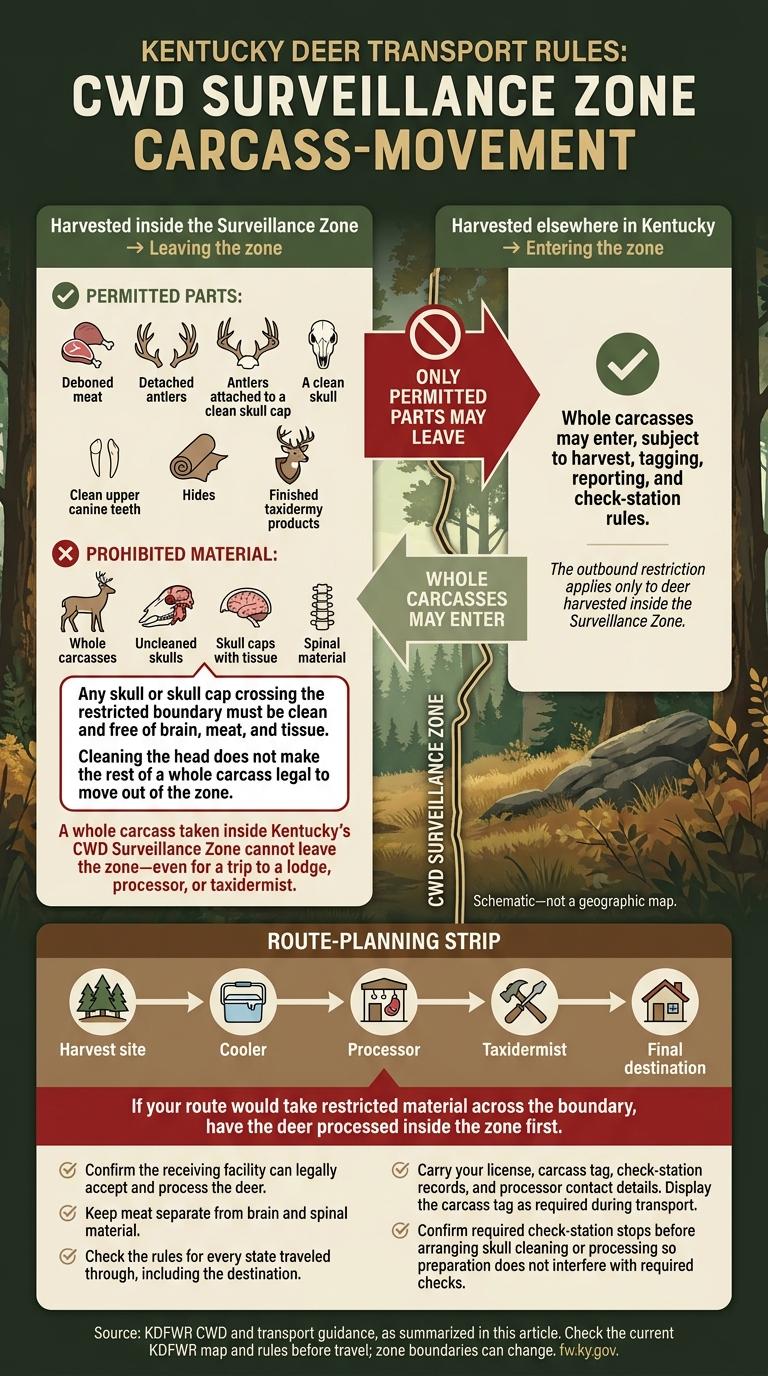
Kentucky CWD Zones: Deer Transport Rules
Before you move a harvested deer, check the rules for where you killed it. Carcass transport restrictions depend on the harvest location - not where you’re headed. A whole carcass taken inside Kentucky’s CWD Surveillance Zone cannot leave the zone, even for a trip to a lodge, processor, or taxidermist.
Check the current Kentucky Department of Fish and Wildlife Resources (KDFWR) map before you travel. Zone boundaries can change.
Deer Parts Allowed Across Restricted Boundaries
Any skull or skull cap crossing the restricted boundary must be clean and free of brain, meat, and tissue. Cleaning the head does not make the rest of a whole carcass legal to move out of the zone.
| Harvest and movement | Permitted parts or movement | Prohibited material and exceptions | Official guidance |
|---|---|---|---|
| Deer harvested inside the Surveillance Zone, leaving the zone | Deboned meat; detached antlers; antlers attached to a clean skull cap; a clean skull; clean upper canine teeth; hides; finished taxidermy products | Whole carcasses, uncleaned skulls, skull caps with tissue, and spinal material cannot leave the zone. | KDFWR CWD guidance |
| Deer harvested elsewhere in Kentucky, entering the zone | Whole carcasses may enter, subject to harvest, tagging, reporting, and check-station rules. | The outbound restriction applies only to deer harvested inside the Surveillance Zone. | KDFWR transport guidance |
Plan Your Harvest Transport Route
Map the harvest site, cooler, processor, taxidermist, and final destination before your hunt. If your route would take restricted material across the boundary, have the deer processed inside the zone first. Confirm that the receiving facility can legally accept and process it. Keep meat separate from brain and spinal material, and check the rules for every state you’ll travel through, including your destination.
Carry your license, carcass tag, check-station records, and processor contact details with the load. Display the carcass tag as required during transport. Confirm any required check-station stops before arranging skull cleaning or processing, so that work does not interfere with the required checks.
Set Up for a Legal Hunt
After checking transport rules, make sure the hunt site is legal before you enter the woods.
Check Feeders and Previously Baited Sites
Check current Kentucky Department of Fish and Wildlife Resources rules for the property’s CWD zone status, land type, and feeder design before using an existing setup.
Turning a feeder off does not make the site legal. Photograph the setup, record when feed or minerals were last placed, and document their removal. Check the department’s current rules for leftover bait at previously baited sites. Verify parcel boundaries and landowner permission, too. Permission to hunt private land does not carry over onto a neighboring WMA.
Once you’ve confirmed the site is legal, plan your access and stand placement.
Choose Stands for Wind, Access, and Deer Movement
Hunting advice - not a legal requirement: Scout natural food sources, trails, pinch points, and routes between bedding cover and feeding areas. Choose a stand where the wind carries your scent away from likely deer travel.
Your approach matters as much as your stand choice. Stay out of bedding cover, avoid busy deer trails, and limit repeated trips along routes already getting hunting pressure.
Confirm Guide Support and Post-Harvest Plans
A guided hunt calls for the same legal checks. Before arrival, confirm the county, property status, feeder setup, and plan for moving a harvested deer.
For a guided, fair-chase hunt in Northeastern Kentucky with Whitetail Hunting Kentucky, check the current package details. Confirm lodging, meals, stand transport, help with field dressing, and returning your harvested deer to the lodge.
Plan processing and transport separately. Field-dressing help and lodge return are not game processing. Confirm who handles required harvest reporting, where the deer can be cooled, and whether a processor will accept it. Before the hunt, check current Kentucky Department of Fish and Wildlife Resources rules to confirm that any planned harvest transfer is legal.
Before-You-Hunt Checklist
Before you leave, check your setup, paperwork, testing requirements, and plan for getting your deer home.
- Location and setup: Save the current KDFWR map and rules. Record the county, land type, deer zone, and CWD zone status separately. Verify that your feeder, bait or attractant, and feeding dates are legal.
- Dates and paperwork: Check your weapon and hunt dates against county and property rules. Carry your licenses, permits, hunter education proof or exemption, harvest log, and carcass-tag materials. Confirm the Telecheck deadline.
- Testing: Check required station dates, hours, and head-preparation rules. Confirm whether you must use a staffed station - a drop-off site may not meet the requirement.
- Cooling and travel: Plan a legal route home before you hunt. Pack ice, coolers, and leak-resistant containers. Map your route to the processor and every restricted boundary you’ll cross. Arrange carcass preparation for transport under the rules described above.
- Right before departure: Recheck KDFWR updates, especially if plans change at the last minute. Current rules take priority over notes from earlier in the season. Save the rules, station hours, processor contact information, and legal route offline.
FAQs
What if my property crosses a CWD zone boundary?
Check the harvest location before moving your deer. Carcass transport rules are stricter within Kentucky’s CWD Surveillance Zone. Boundaries can change between seasons, so confirm where your hunting property falls on the current Kentucky Department of Fish and Wildlife Resources (KDFWR) CWD map.
If you harvest a deer inside the zone, don’t haul the whole carcass, head, or spinal tissue outside it. Process it into permitted parts first, such as deboned meat, cleaned skull plates, antlers, and hides. Check current KDFWR transport rules for cleaning requirements and any exceptions before leaving the zone.
Can I drive through another zone with my harvested deer?
In general, you cannot take a whole deer carcass out of a CWD Surveillance Zone. Only low-risk parts - such as deboned meat, cleaned skull caps, antlers, prepared hides or capes, and finished taxidermy mounts - may leave the zone.
Check the rules before you travel. Confirm the current zone map and carcass restrictions with the Kentucky Department of Fish and Wildlife Resources. Also check your home state’s deer import requirements, which may be stricter.
What if CWD rules change after I book my hunt?
Plan your travel and deer processing around the current CWD rules. Check the CWD Surveillance Zone map and Kentucky Department of Fish and Wildlife Resources regulations immediately before your trip.
If a zone change affects your hunt, have your deer processed into parts allowed for transport before leaving the restricted area or crossing state lines. Check your home state’s deer import rules, too. Those rules are separate from Kentucky’s and may be stricter.