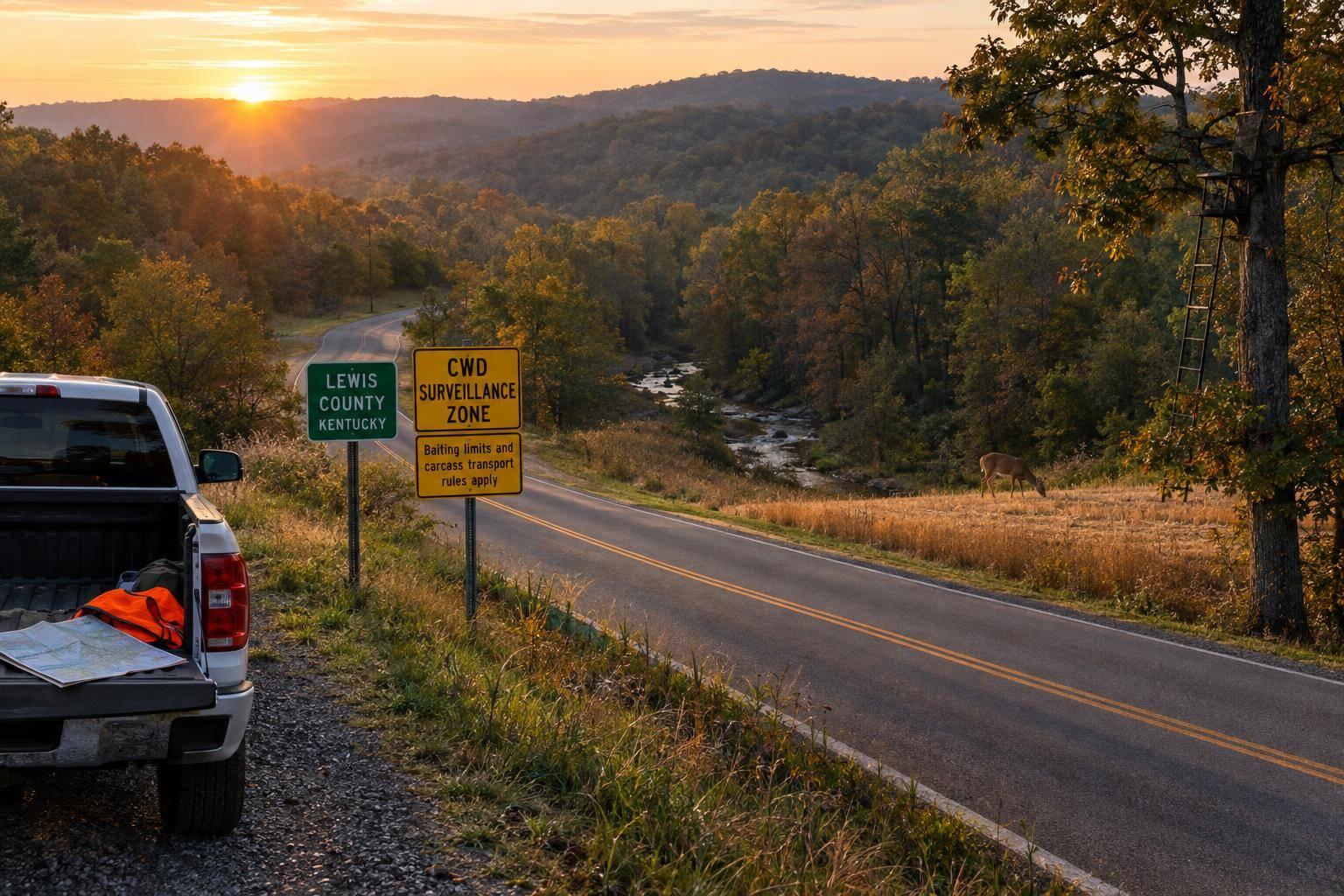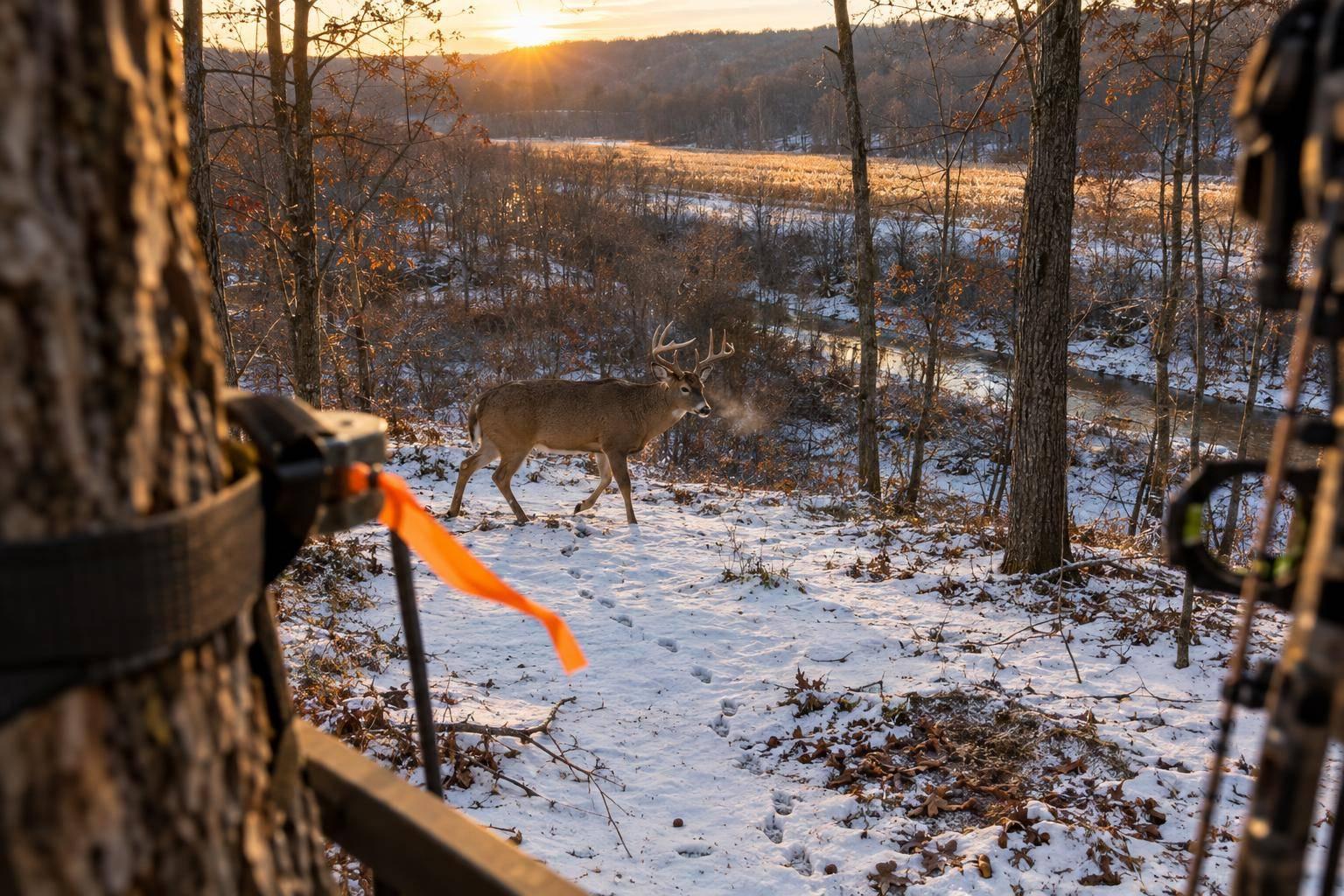
Tracking deer in Kentucky without snow is challenging but achievable with patience and attention to detail. Unlike snowy regions, hunters must rely on subtle ground signs like tracks, flipped leaves, and scat. Here’s a quick breakdown of key strategies:
- Tracks: Look for sharp, well-defined prints in muddy or damp areas. Mature bucks leave tracks wider than 3 inches and often drag their feet, flipping leaves.
- Signs: Fresh rubs, scrapes, and moist droppings indicate recent activity. Bucks tend to mark travel routes and bedding zones.
- Bedding Areas: Focus on brushy ridges, saddles, and dense cover for likely buck bedding spots. Tracks leading uphill during midday often point to these locations.
- Scouting: Use topographic maps, trail cameras, and on-foot exploration. Pay attention to terrain features like ridges, creek crossings, and funnels.
- Stealth: Move slowly and quietly, especially in dry, leaf-covered woods. Manage scent by tracking from downwind and avoiding direct deer trails.
How To Get A BIG BUCK with No Snow | “THE NEW NOVEMBER NORMAL”
Reading Ground Sign Without Snow
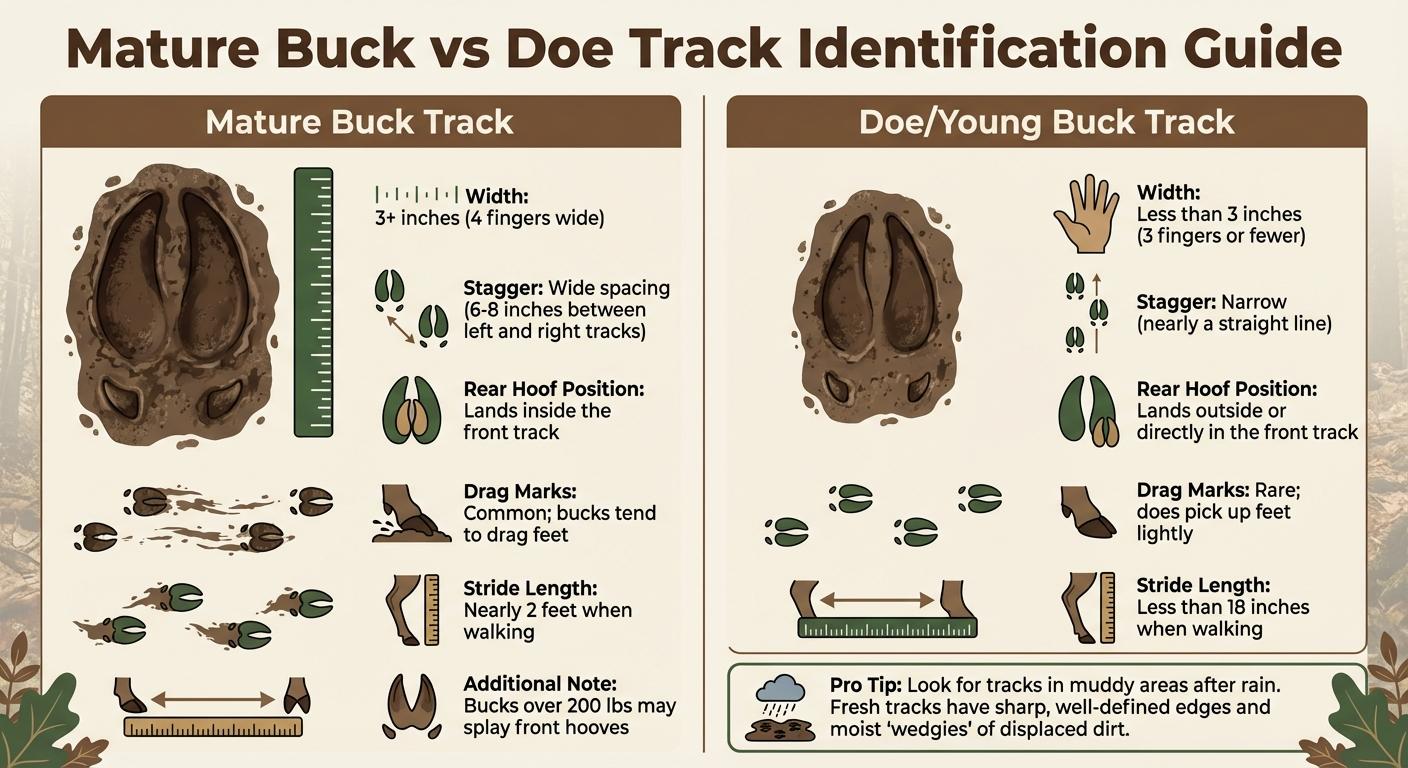
How to Identify Mature Buck Tracks vs Doe Tracks in Kentucky
When there’s no snow to guide you, the ground in Kentucky’s hardwood forests still holds plenty of clues – if you know how to look. Tracks, disturbed leaves, and other subtle signs can tell you where deer have been walking, feeding, or bedding down. The key is slowing down and paying close attention to the details.
Finding and Dating Deer Tracks
Spotting deer tracks on bare ground takes patience and the right conditions. After a rain or in muddy areas near creeks, tracks become easier to see. Fresh tracks are sharp and well-defined, while older ones have softer edges as weather wears them down.
One trick to gauge a track’s age is checking the soil’s moisture. When a deer steps into mud, small pieces of dirt – known as "wedgies" – are displaced. If these chunks are still moist and loose, the track is likely less than a day old. If they’ve dried and hardened, the track is much older. As expert tracker John Wright explains:
"Big heavy bucks will leave big heavy tracks in mud just like they would in the snow, and if he’s a really good one, you’ll have no problem following him."
Debris inside the track can also help you judge its age. Windblown leaves, pine needles, or insects in a hoof print suggest the track has been there for a while. In Kentucky’s damp forests, look for tracks pressed through wet leaves. Mature bucks often drag their feet, flipping leaves over to expose the darker, damp underside. This creates a visible trail even on hard ground.
Distinguishing a buck’s track from a doe’s requires practice. Size is a major factor: tracks wider than 3 inches – about the width of four fingers – usually belong to a mature buck. Bucks also have a wider "stagger", the distance between left and right tracks, which ranges from 6 to 8 inches due to their broader chests. Does, on the other hand, walk in nearly straight lines. Another difference lies in how their rear hooves land: bucks’ rear hooves often step slightly inside their front tracks, while does’ rear hooves land outside or directly on top of their front tracks.
| Feature | Mature Buck Track | Doe / Young Buck Track |
|---|---|---|
| Width | 3+ inches (4 fingers wide) | Less than 3 inches (3 fingers or fewer) |
| Stagger | Wide (6–8 inches) | Narrow (nearly a straight line) |
| Rear Hoof | Lands inside the front track | Lands outside or directly in the front track |
| Drag Marks | Common; tends to drag feet | Rare; tends to pick up feet lightly |
A mature buck’s stride can reach nearly 2 feet when walking, compared to less than 18 inches for an average whitetail. Bucks weighing over 200 pounds may even splay their front hooves.
Identifying Scat, Rubs, and Scrapes
Deer leave more than just tracks – they also leave droppings, rubs on trees, and scrapes on the ground. Fresh scat is moist and dark, while older droppings dry out and lose their shine. Pairing fresh droppings with tracks can confirm recent activity in the area.
Tree rubs are another telltale sign. Bucks use their antlers to strip bark from trees, marking travel routes and signaling breeding activity. Scrapes, on the other hand, are patches of cleared earth under low-hanging branches. Bucks paw the ground and urinate in these spots to leave their scent. As Laura Palmer, a biologist with the Kentucky Department of Fish and Wildlife Resources, puts it:
"Animal tracking does not only include looking for animal tracks… There are many other signs that animals leave: bear scratches on trees, squirrels stripping bark, deer rubs, scat, and slides."
Clusters of rubs and scrapes often appear near bedding areas or feeding zones, offering clues about a buck’s core territory.
Finding Bedding Areas
Bedding areas are where deer spend much of their daylight hours. In Kentucky’s terrain, mature bucks often prefer brushy ridges that taper to a point. These spots provide good sight lines, wind coverage, and sun exposure. Alex Gyllstrom of Whitetail Properties explains:
"In high terrain, mature deer favor those thick, brushy ridges that come to a point. Just off of those points is where you’ll find those mature bucks really like to bed and spend a lot of time."
Look for flattened vegetation or oval-shaped depressions in dense cover. Bucks often position themselves to watch their back-trail while using the wind to detect danger from above. Other common bedding spots include areas with thick understory, saddles between ridges, and remote interior zones with little human activity. In colder months, softwood stands like cedar or spruce provide thermal cover.
Tracks heading uphill toward ridge saddles during midday often indicate a buck moving toward his bedding area. Scout for clusters of rubs, scrapes, and broken licking branches nearby. Using topographic maps can help you locate brushy ridge points and other high-probability bedding sites.
Scouting Methods for Kentucky Terrain
Kentucky’s diverse landscape – marked by hardwood ridges, creek bottoms, and agricultural edges – requires a thoughtful approach to scouting. Success hinges on gathering information subtly and minimizing human scent. By combining on-foot exploration with technology, you can uncover the paths bucks are using and improve your tracking efforts.
Physical Scouting on Foot
Walking the terrain offers insights that cameras and maps simply can’t provide. The best time to scout is during or just after rain. Wet conditions not only quiet your movements but also leave muddy ground ideal for spotting fresh tracks. Keep an eye out for clusters of fresh rubs, scrapes, and droppings, which often mark travel routes between bedding and feeding areas.
Kentucky’s terrain naturally guides deer movement. For example, saddles between ridges often serve as prime travel corridors, especially at midday when bucks move uphill to bed. Old logging roads, clear-cuts, and stream crossings are other hot spots to check, as soft ground in these areas tends to capture clear tracks. On hardwood ridges, look for overturned leaves exposing their dark, damp undersides – these can reveal both the presence of deer and their direction of travel.
If tracks disappear on hard ground, try circling the area to find additional signs like rubs, scrapes, or fresh tracks to confirm the deer’s path. As tracker Timmy Bolduc advises:
"On bare ground, you should be almost constantly in death creep mode like you’re still-hunting… expecting to see the buck at any second."
When scouting ridges, take the high ground – bucks often bed facing downhill to monitor for disturbances.
The 2024–2025 season saw hunters achieve notable success with mature bucks, highlighting how these deer use the terrain strategically. Late in the season, focus on high-energy food sources like standing corn, soybeans, and brassicas (e.g., turnips and radishes), as cold fronts can drive deer movement toward these areas.
Placing Trail Cameras for Best Results
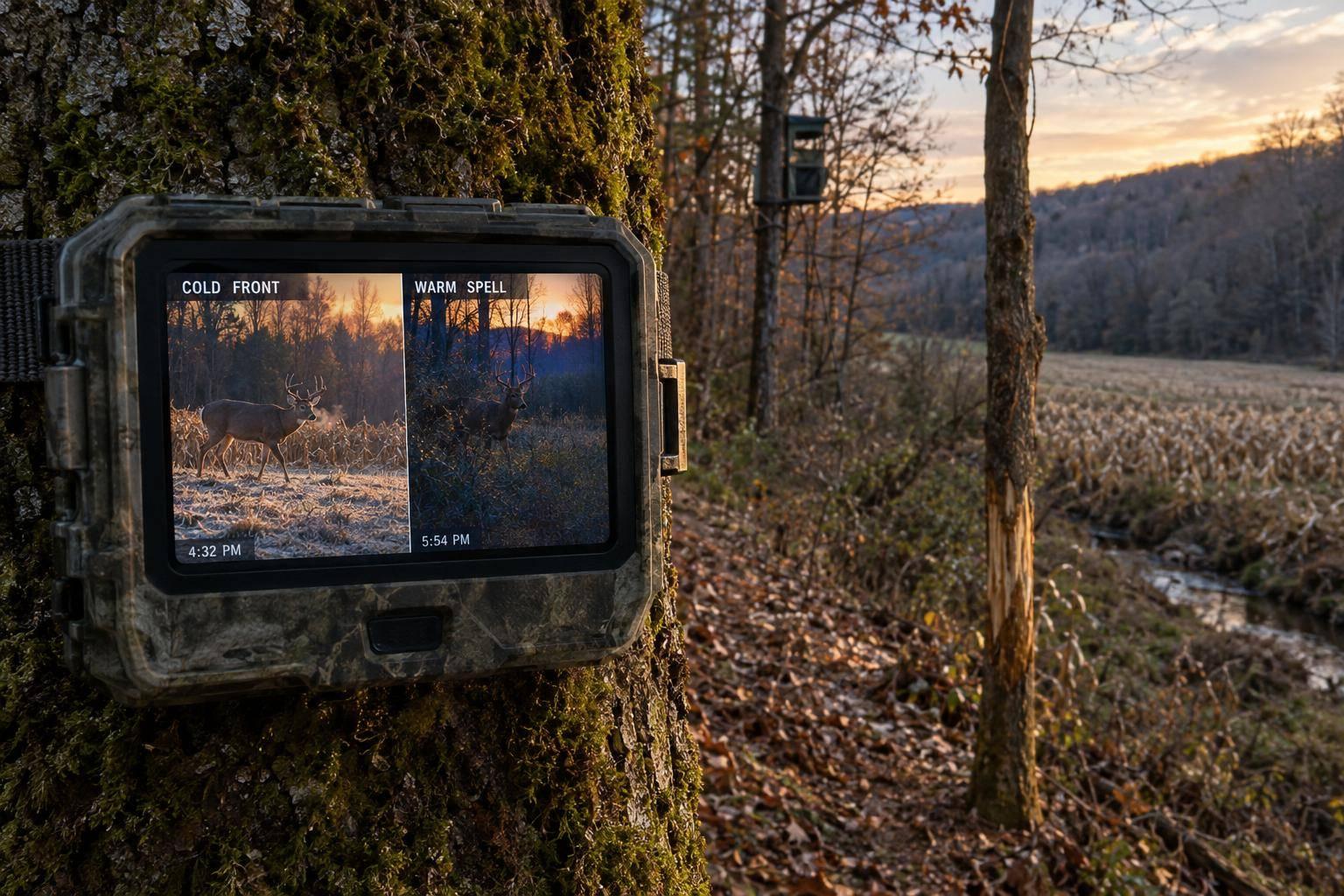
Trail cameras are invaluable when physical signs are scarce. Think of your property as a bicycle wheel: the hub represents bedding areas, the spokes are travel corridors, and the rim marks the food sources. Placing cameras along these travel corridors can provide a clearer picture of buck activity.
Set up cameras in high-traffic areas such as property corners, edges of food sources, and transitions near bedding zones. Look for signs like high pellet counts, urine marks, rubs, and scrapes to pinpoint the best locations. Deer often favor edges where woodlands meet open fields or clearings, making these spots ideal for camera placement. Deploying cameras mid-season can be particularly effective as bucks settle into their fall home ranges.
Choose cameras with infrared capabilities and no red glow to avoid startling mature bucks. When checking your cameras, take low-impact routes to minimize disturbance. Some hunters even use ATVs or UTVs, as their engine noise may be less alarming than human scent. Jeff Sturgis, founder of Whitetail Habitat Solutions, emphasizes:
"By covering your corners of high established deer movement patterns with a trail cam during the hunting season, the level of accuracy for your deer survey can be extremely high not only your own land, but for the entire neighborhood."
Using Topographic Maps and Digital Tools
Topographic maps are a powerful tool for identifying the terrain features that influence deer movement. Before heading out, study these maps to locate natural funnels like saddles, ridge points, and areas where the land narrows. Mature bucks often bed on thick, brushy ridges that taper to a point, where wind, sunlight, and sightlines provide an advantage.
Enhance your scouting by overlaying aerial imagery with topographic maps. Aerial views reveal cover types like timber, brush, and fields, while topographic maps highlight elevation changes that shape deer travel routes. Keep an eye out for smaller, dense cover near roads or structures, as deer often use these areas to avoid human contact. Linear features such as fencelines, waterways, and narrow timber strips frequently serve as travel paths. Creek crossings and drainage systems are also reliable movement funnels. Hardwood ridges may indicate mast crop locations, while agricultural edges and grain stubble can point to late-season feeding zones. Use GPS to mark waypoints on fresh signs, helping you identify ideal spots for long-term camera placement.
| Property Size | Recommended Cameras | Primary Placement Strategy |
|---|---|---|
| 40 Acres | 3–4 Cameras | Corners of high movement patterns |
| 100 Acres | 5–6 Cameras | Established travel corridors |
| 300+ Acres | 6–10 Cameras | Major food sources and bedding transitions |
Tracking and Stalking Techniques
Once you’ve identified fresh signs, the real challenge begins: closing the gap without alerting your target. Tracking deer on Kentucky’s bare ground demands a unique approach, as every step you take and even the slightest wind shift can influence a deer’s behavior.
Managing Wind Direction and Scent
Your scent is your biggest giveaway when tracking whitetails. Bucks are particularly wary, often keeping an eye on their back trail and anticipating danger to come from below. To avoid spooking them, steer clear of walking directly on active deer trails or crossing them upwind. Instead, when approaching suspected bedding areas, take a wide circle and come in from above. As seasoned deer tracker Timmy Bolduc advises:
"Bucks heading into bedding areas are usually watching their back trails and expecting danger to come from below them. If you circle around and drop into those spots, you can often find that buck bedded down and shoot him before he even knows you’re there."
To stay ahead, use your smartphone to monitor wind direction and ensure your scent isn’t drifting toward active zones. If you’re planning to set up a stand, minimize the time spent studying tracks in the area to avoid leaving too much of your scent behind.
Moving Quietly Through the Woods
Beyond managing scent, your movement must be equally stealthy. Rainy days are ideal for tracking because the dampness quiets dry leaves, creating a near-silent path. On bare ground, move deliberately: take a few slow, measured steps, pause to scan your surroundings, and then proceed.
Pay close attention to where you step to avoid crunching leaves or snapping twigs. Maine Master Guide Hal Blood emphasizes the importance of this:
"Every step you take matters. You can’t break a branch or rustle the leaves. Plan out each step and keep your eyes up."
When navigating through thick brush, ditch the backpack – its straps and frame can snag on branches and create unwanted noise. Instead, use a quiet wool fanny pack tucked under your jacket. Tape your pant legs over your rubber boots to prevent flapping. Wool clothing is especially useful because it stays quiet when brushing against vegetation and retains warmth even when wet. If you happen to spook a deer, stop and wait for about 30 minutes; once the animal calms down, it will often return to a normal walking pace.
Interpreting Deer Behavior and Adjusting Tactics
Once you’ve mastered a silent approach, the next step is to read the deer’s behavior. You can gauge a buck’s activity by examining its stride. For example, a stride measuring 24–26 inches suggests the deer is traveling, which means you’ll need to pick up your pace to close the distance. Hal Blood puts it plainly:
"I don’t care how fast you can walk or even jog, you ain’t moving as fast as a buck just walking along."
If you notice a shorter stride or a milling pattern, the deer may be feeding, bedding, or distracted. In these cases, slow down and move with maximum stealth. Drag marks in the leaves often indicate that a buck is tired and searching for a spot to bed down.
When the trail becomes unclear in dense cover, avoid pushing straight through. Instead, walk a wide circle around the area to locate where the buck’s track exits.
| Deer Stride Pattern | What It Means | Tactical Response |
|---|---|---|
| Long stride (24–26") | Buck is traveling steadily | Move quickly to close distance |
| Short/irregular stride | Feeding or preparing to bed | Slow to maximum stealth |
| Drag marks visible | Tired and seeking bedding | Employ maximum stealth |
| Milling/wandering | Distracted by food or scouting | Pause frequently and scan |
Gear for Tracking Without Snow
Tracking without the advantage of snow means relying on every tool at your disposal to uncover subtle signs. The right gear can be the difference between success and frustration when navigating Kentucky’s leaf-covered terrain. From pinpointing tracks to moving stealthily, having the proper equipment is essential.
Navigation and Optics Equipment
A reliable GPS mapping app, like onX Hunt, is a must-have for tracking on bare ground. Use it to drop waypoints on fresh tracks, rubs, or scrapes as you find them. The Tracker feature helps you log your path, and you can even overlay wind direction to ensure your scent doesn’t blow toward bedding areas. If the trail goes cold, your waypoints can guide you back on track.
Binoculars are another critical tool. When moving slowly and deliberately, pausing every few steps to scan ahead can help you spot a buck before it notices you. If you’re serious about tracking, a thermal monocular can give you an edge in cooler weather by detecting heat signatures that might otherwise go unnoticed.
Don’t overlook simple tools, either. A ruler can help verify track size – if a track spans four fingers, it could indicate a buck weighing over 200 pounds. Laura Palmer, a Furbearer Biologist with the Kentucky Department of Fish and Wildlife Resources, emphasizes the importance of preparation:
"Carry a guide to animal tracks as well as a ruler that will show up clearly in photographs".
For a broader perspective, trail cameras can be an invaluable addition to your tracking strategy.
Trail Cameras and Scouting Equipment
Trail cameras are like having extra eyes in the woods. To avoid alarming mature bucks, opt for no-glow or black flash models instead of those with red-glowing IR bulbs. Place cameras along established travel routes between bedding and feeding areas rather than over bait piles. Mature bucks tend to stick to predictable paths, especially during the peak activity period from late September through late October.
For added convenience, download the Kentucky Department of Fish and Wildlife Resources’ pocket guide to animal tracks from their website (fw.ky.gov). This can help you quickly identify tracks in the field.
While technology can extend your reach, your comfort and mobility are just as crucial for effective tracking.
Clothing and Footwear for Mild Weather Hunts
Heavy gear can slow you down, especially over long distances. Opt for lightweight, flexible fabrics that keep you warm without restricting movement. Merino wool or synthetic blend hoodies and quarter-zips strike a good balance for active tracking. For pants, look for mid-priced "flex" series options designed to move with you through dense brush without causing noise.
Footwear is just as important. Swap out heavy, insulated boots for high-quality hiking boots that provide support and comfort during long tracking sessions on uneven terrain. Todd Amenrud from Mossy Oak offers this insight:
"The last thing you want is to have to attempt a fast-moving shot as the weight of carrying winter deer hunting gear can impede your speed and agility".
Even in mild weather, scent control is critical. Treat your clothing with scent-eliminating products to reduce human odor, as mature bucks have an exceptional sense of smell. Combining these gear choices with a quiet, deliberate approach is key to thriving during Kentucky’s bare-ground hunts.
Conclusion
Hunting whitetails in Kentucky without the help of snow calls for careful observation and smart use of your tools. The key is to focus on fresh signs – like moist scat, recent rubs, or flipped leaves – instead of getting distracted by every track you come across. As Timmy Bolduc suggests, when visible trails disappear, slow down and work the signs you do find.
Topographic maps can be a game-changer. Use them to identify areas like saddles, ridges, and funnels – spots that typically indicate buck movement. For instance, if you notice a track heading uphill toward a saddle during midday, chances are a buck is heading to bed. Position yourself above the trail and approach from downwind to increase your chances of an encounter. Combining these terrain features with digital tools can help you mark fresh signs and better understand how deer move across your hunting area.
Success often lies in the details. Pay attention to track size and patterns to estimate a buck’s maturity. Look for subtle signs like flipped leaves exposing their damp underside or small, six-inch circles where deer have scratched through leaf litter in search of acorns.
Consistency is key to improving these skills. Wet days are especially helpful, as mud holds fresh tracks more clearly. Over time, training your eyes to notice subtle changes will sharpen your ability to predict where bucks are bedding, feeding, and traveling – even on bare ground. By mastering these techniques, you’ll strengthen your scouting and tracking habits, setting yourself up for more successful hunts in Kentucky.
FAQs
How can I tell the difference between a mature buck’s tracks and a doe’s tracks without snow?
When trying to distinguish a mature buck’s tracks from a doe’s on bare ground, focus on hoof spread, stride, and ground disturbance – these details can reveal a lot.
Mature bucks typically leave tracks that are wider, with front hooves showing a distinct toe splay, often measuring about 4 inches across. This happens because of their heavier weight. On the other hand, a doe’s tracks are narrower, with hooves that stay closer together. Bucks also tend to have a longer and more consistent stride, and their movements often disturb the ground more noticeably. You might see deeper impressions or wider disruptions in leaf litter, while a doe’s tracks usually show less ground disturbance and more parallel hoof placement.
In Kentucky’s terrain, look for flipped leaves – bucks often push leaves aside with greater force, exposing their damp undersides. If the wet side of a flipped leaf is still visible, it’s a good indicator that the track is fresh. In frozen conditions, fresh tracks will break through the crust of hard mud, while older ones will appear sealed under the freeze. By combining these subtle clues, you can pinpoint a mature buck’s trail, even when snow isn’t present.
How can I find deer bedding areas in Kentucky without snow?
To find deer bedding areas in Kentucky’s snow-free environment, start by using topographic maps or GPS apps to identify promising locations. Focus on north-facing slopes, dense cover, and low-lying draws – these spots offer deer both concealment and comfort. Set up trail cameras near food sources, water, and travel paths, and monitor them for about 10–14 days to detect patterns of repeated bedding activity.
When scouting on foot, keep an eye out for signs such as compressed leaf litter, flipped leaves (revealing their wet underside), or small 6-inch circles where deer have cleared leaves to feed on acorns or browse. Look for fresh rubs, scrapes, and tracks as well. Pay attention to gait patterns to differentiate between bucks and does: bucks tend to leave splayed-toe tracks with longer strides, while does typically have closed-toe tracks with shorter, uneven steps. To determine the freshness of tracks or beds, check if the ground’s crust is broken or still frozen after a hard freeze.
Seasonal behavior can also provide clues. During summer, deer prefer cool, shaded spots close to food. In fall, they shift to ridges that offer protection from the wind. By spring, they gravitate toward low valleys with fresh vegetation. By combining these seasonal tendencies with observed signs, you can more precisely locate bedding areas and increase your chances of hunting success.
What are the best ways to use trail cameras to track deer in Kentucky’s terrain?
Using trail cameras in Kentucky’s varied landscapes requires thoughtful placement and setup to get the best results. Start by choosing rugged cameras with solid night vision capabilities, like infrared with no visible flash, and a resolution of at least 1080p for clear images. Position your cameras along natural travel paths such as ridgelines, creek beds, or bedding areas. Look for signs like deer rubs, tracks, or small feeding spots (those little "kick-out" circles) to guide your placement. Mount the camera 3 to 5 feet above the ground, angling it slightly downward, and clear away any branches or debris that could trigger false alerts.
For optimal performance, adjust the camera settings to high motion sensitivity, capture 2–3 photos per trigger, and eliminate delays between shots. Use no-glow infrared to keep deer from noticing the camera, and blend it into the surroundings with natural camouflage. Space your cameras roughly 10–15 acres apart, and let them remain undisturbed for at least two weeks before checking the images. Once you’ve collected photos, study them for movement patterns and activity times. This data can help you fine-tune your hunting plan and pinpoint the best spots for stands or baiting. These methods make tracking deer movements effective, even without snow to highlight their trails.