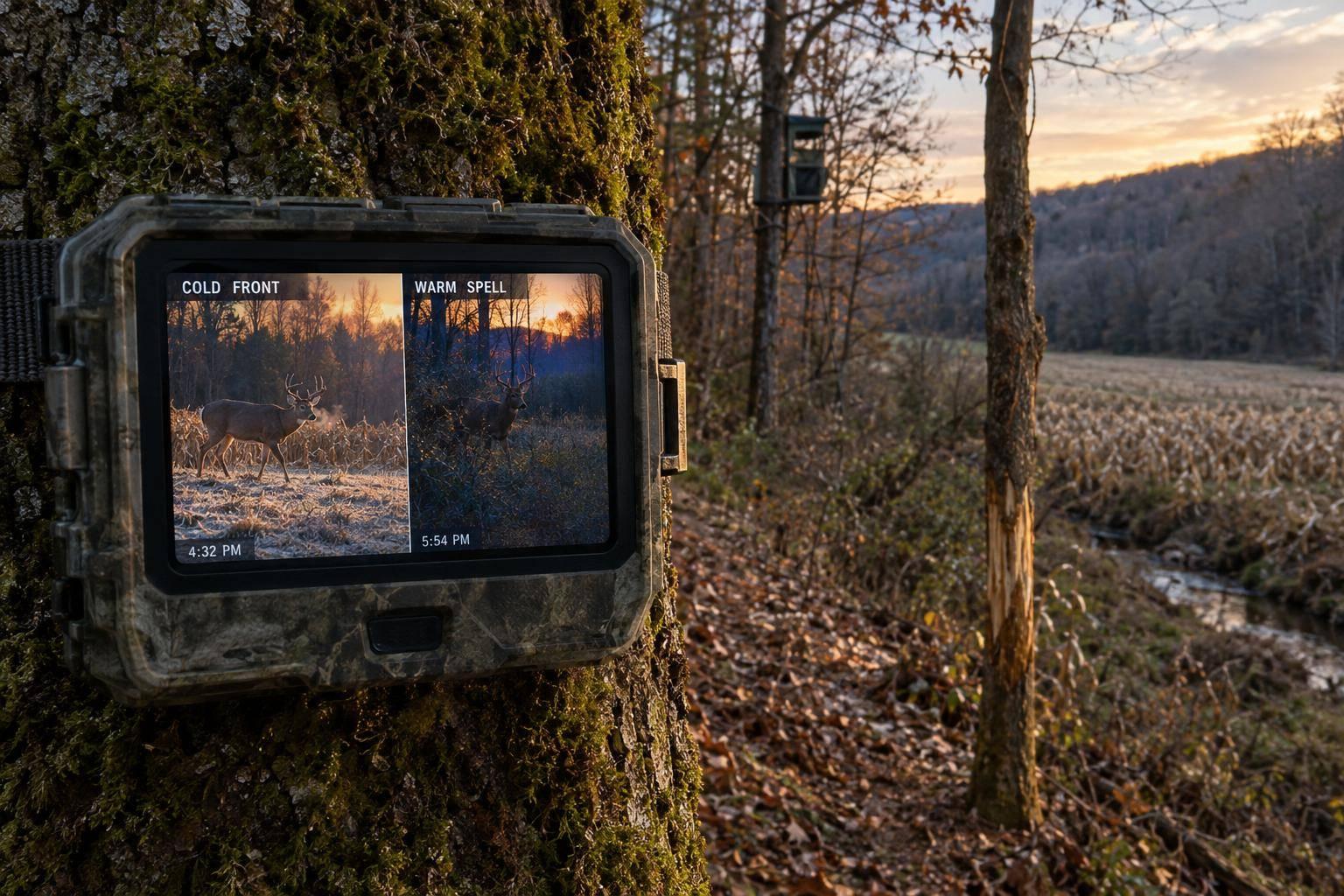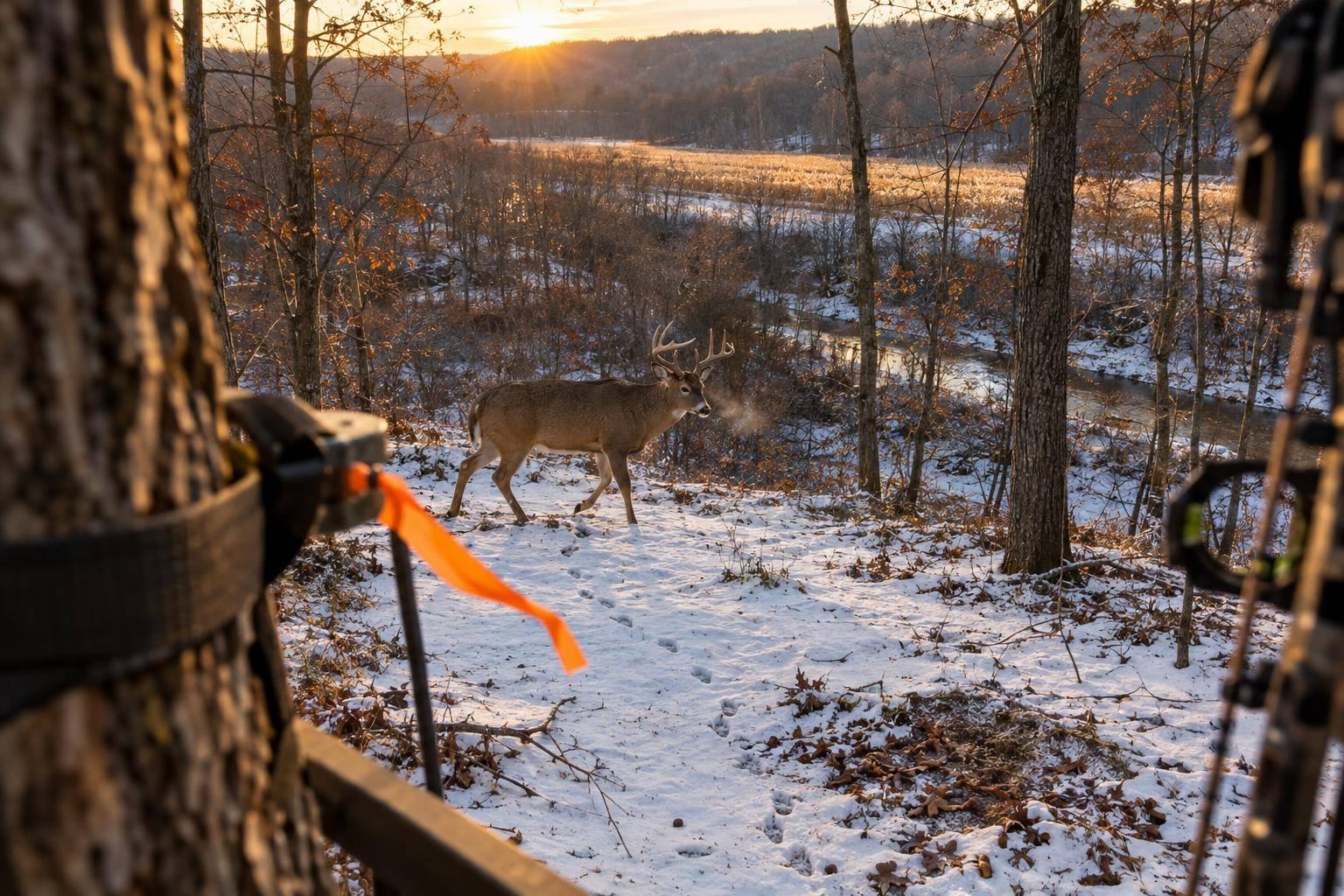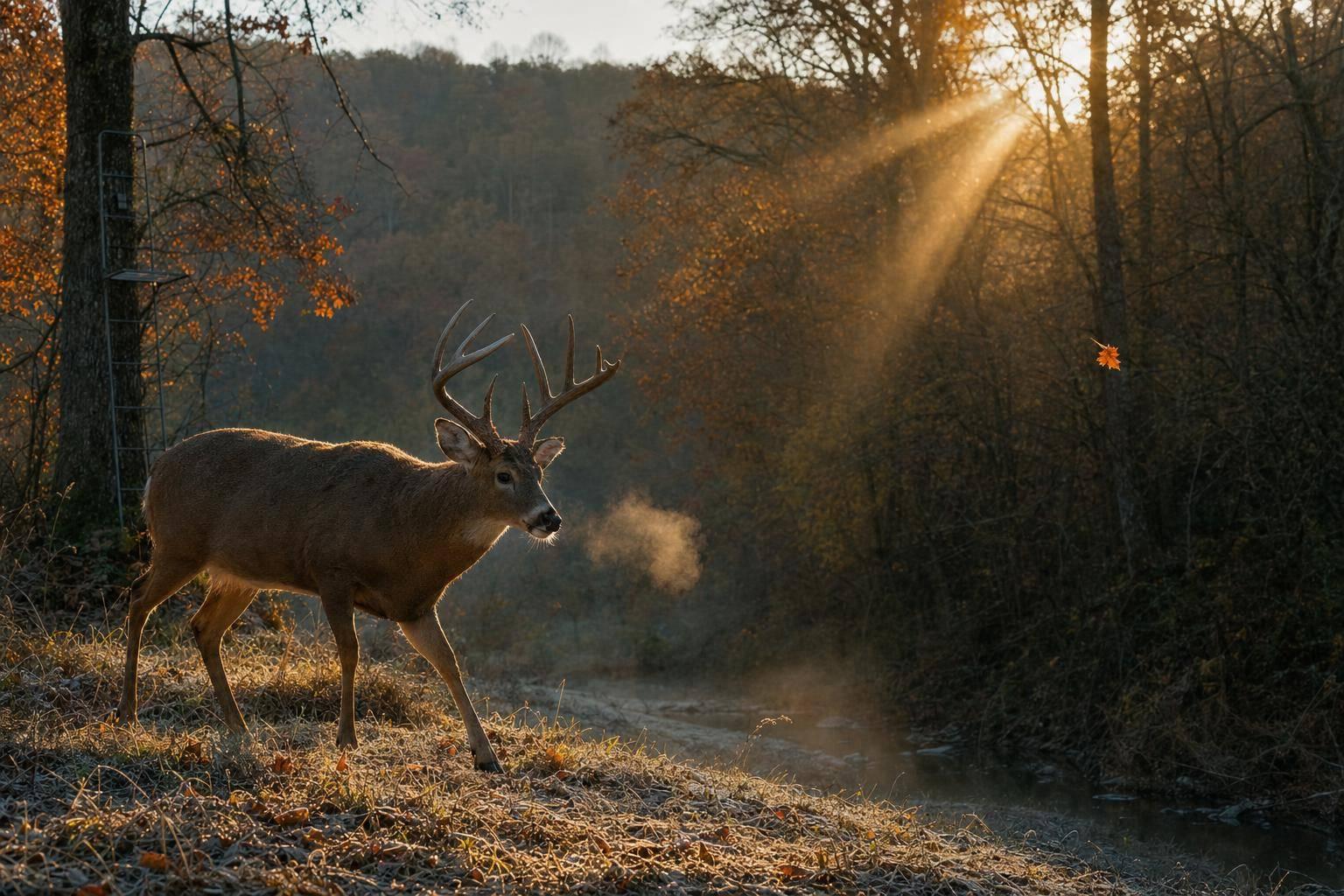
Want to consistently locate mature bucks during daylight hours? Understanding their bedding habits is the key. Bucks spend up to 75% of their time bedded, making these areas the foundation of their movement patterns. A bedding audit helps hunters pinpoint these critical spots by analyzing terrain, seasonal influences, and behavior.
Key takeaways:
- The best time to scout bedding areas is late winter to early spring when signs like rubs, trails, and matted vegetation are visible.
- Mature bucks prefer elevated terrain, dense cover, and wind advantages for bedding, often choosing south-facing slopes in colder months.
- Bucks position themselves with the wind at their back for security, using thick cover for protection and thermals to monitor their surroundings.
- Seasonal changes and hunting pressure influence bedding locations, with bucks shifting closer to food sources early in the season and retreating to dense cover post-rut.
- Trail cameras placed on travel routes, not directly in bedding areas, can reveal patterns without disturbing the site.
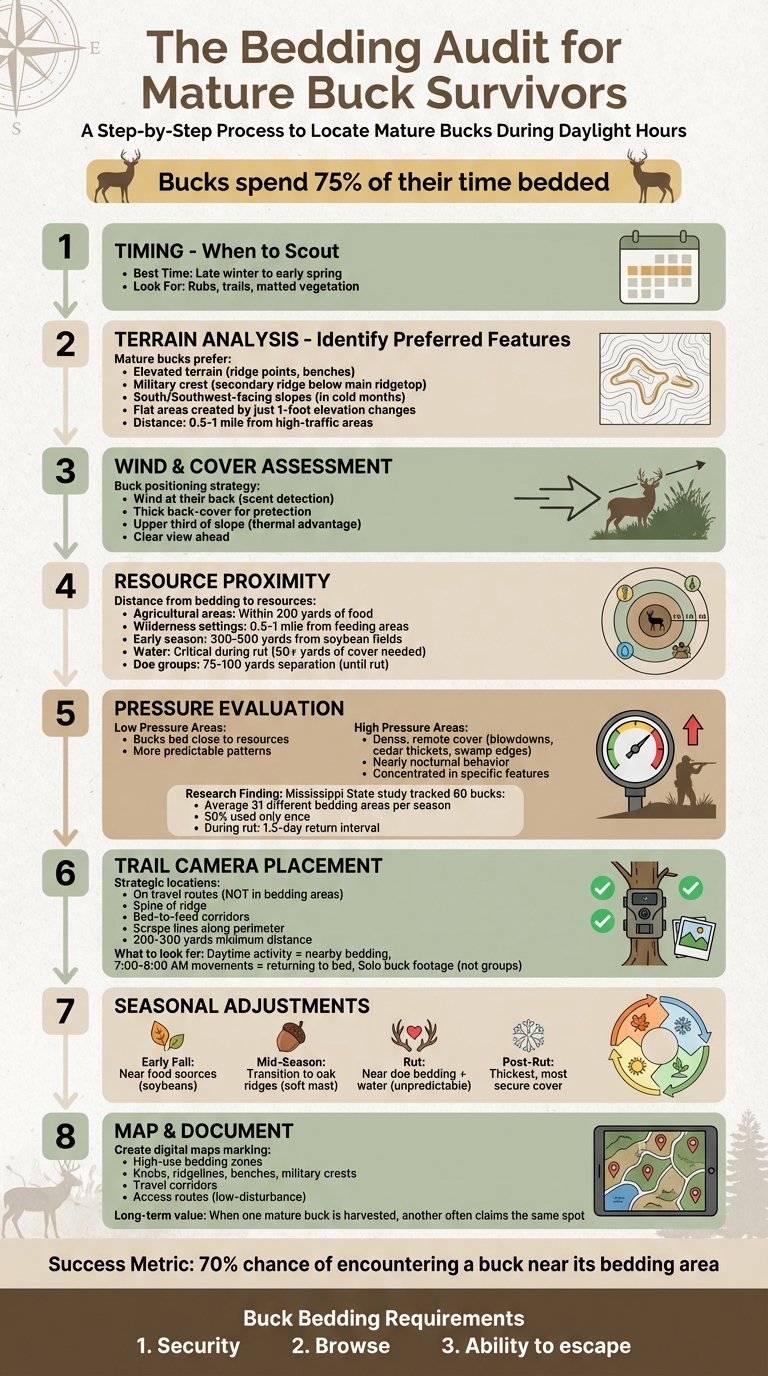
Mature Buck Bedding Audit: Step-by-Step Process for Hunters
How To Find A Buck’s Bedding Area
Terrain Features Mature Bucks Prefer for Bedding
Mature bucks are highly selective when it comes to bedding areas. They seek out spots with elevation, dense cover, and favorable wind conditions to detect danger early. In northeastern Kentucky’s rugged hill country, these factors make it easier to predict where these elusive bucks spend their daylight hours.
Elevated terrain, such as ridge points and benches, offers bucks a commanding view of the surrounding area while providing quick escape routes. In steep hollows, even small flat areas – created by just a 1-foot elevation change – can become ideal bedding spots. Bucks in high-pressure areas may also prefer low flats at the back of draws, where challenging access and swirling winds discourage hunters. Understanding these subtle terrain features is key to pinpointing bedding locations.
South-facing and southwest-facing slopes are particularly appealing in colder months. These slopes soak up sunlight for warmth and channel headwinds that alert bucks to potential threats. Mature bucks often bed a half mile to a mile away from heavily trafficked or high-risk areas, ensuring their safety during daylight hours.
How to Identify Preferred Terrain
One often-overlooked bedding feature is the military crest – a secondary ridge just below the main ridgetop. This position keeps bucks hidden from the skyline while giving them a clear view of the terrain below.
"The military crest is below the actual crest of a ridge top, and is basically the 2nd crest that you will find, before dropping over the edge and down the slope… Bucks in these areas can be tucked away from the exposure of cold winds from above, while enjoying a commanding view of lower habitat elevations."
- Jeff Sturgis, Founder, Whitetail Habitat Solutions
When scouting Kentucky ridges, use topographic maps to locate these secondary crests. Look for flat lines nestled between steep contour lines – these are the benches where bucks often bed. Transition zones are another key area to scout. Bucks frequently bed along edges where dense cover like cedar thickets or briars meets open hardwoods. These "creatures of edge" thrive in areas where cover and visibility intersect.
Isolated beds are another telltale sign of a mature buck. Unlike does, which bed in groups, a single oval depression in thick, secluded cover often indicates a buck’s preferred spot. These beds are typically found in hard-to-reach areas, such as overgrown clear-cuts, blowdowns, or dense swamp edges.
Recognizing these terrain features naturally leads to a better understanding of how bucks use wind and cover to stay secure.
How Bucks Use Wind and Cover for Security
Wind direction plays a critical role in a mature buck’s bedding strategy. Bucks almost always position themselves with the wind at their back, allowing them to smell anything approaching from behind while keeping an open view ahead.
"A mature buck will prefer to bed with the wind at his back… so he can smell anything coming from behind him."
- Mike Manley, Retired Green Beret and Bow Hunter
Thick back-cover is equally essential. Bucks rely on dense vegetation, logs, or rocks to block access from behind, forcing threats to approach from the front, where they have clear visibility.
In Kentucky’s hill country, bucks also take advantage of rising thermals. Bedding in the upper third of a slope allows them to scent-check the area below as the morning air warms and carries scents upward. This thermal advantage enables a buck to monitor a wide area without moving. For hunters, the best time to target these spots is one to four hours after sunrise, when thermals are most active.
How Bedding Area Location Affects Buck Behavior
Buck bedding locations are deeply influenced by the availability of food, water, and proximity to doe groups. For instance, in Kentucky’s agricultural landscapes, bucks tend to bed within 200 yards of food sources. However, in wilderness settings, they may bed as far as 0.5 to 1 mile away from high-risk feeding areas. Recognizing these patterns can help predict their daytime movements and guide hunting strategies.
At the start of the season, bucks typically bed 300 to 500 yards from soybean fields. Instead of bedding directly near food, mature bucks prefer secluded spots with "daytime food" sources like greenbrier, dogwood, and brambles. These areas allow them to graze safely while staying hidden.
Water is another critical factor, especially during the rut. Bucks may go without food during peak breeding periods, but their need for water increases significantly. In flat agricultural areas, river systems and interior ditches often determine bedding locations, provided there’s at least 50 yards of cover separating them from hunting pressure. Swamp edges, which offer both ample browse and multiple escape routes, are also prime bedding spots.
Interestingly, mature bucks avoid active doe groups until the rut. When the rut begins, bucks shift their patterns, moving closer to doe bedding areas. They often scent-check these areas from the downwind side, typically mid-morning when does are resting. This behavior highlights the importance of travel corridors between buck and doe bedding areas, making them prime hunting locations during this period. These movements also illustrate how hunting pressure can further influence bedding choices.
Bedding Sites in Low-Pressure vs. High-Pressure Areas
The level of hunting pressure plays a major role in where bucks choose to bed. In low-pressure areas, bucks stay close to key resources. In contrast, high-pressure environments push them into dense, remote cover, where they adopt nearly nocturnal behaviors. On Kentucky’s public lands, under heavy hunting pressure, bucks often retreat to secluded spots like blowdowns, cedar thickets, swamp edges, or low flats behind draws. These areas are harder for hunters to access due to swirling winds. In such large, unbroken habitats, scouting can be simplified since bucks concentrate in very specific, remote features. Mature bucks also require at least 75 to 100 yards of secure separation from doe bedding areas to feel safe enough to bed on mid-range benches or points.
A study conducted by the Mississippi State University Deer Lab tracked 60 adult bucks in the Big Black River region between October 2023 and January 2024. Using GPS collars, researchers found that each buck used an average of 31 different bedding areas during the hunting season, with half of those areas being used only once. During the rut, bucks revisited specific bedding areas more frequently, with an average return interval of 1.5 days.
These findings highlight how hunting pressure influences bedding behavior and set the stage for understanding how bucks adjust their habits throughout the year.
How Seasonal Changes Affect Bedding Locations
Seasonal shifts in resource availability and hunting pressure drive changes in buck bedding patterns. In early fall, when temperatures are still warm and soybeans remain green, bucks bed near these food sources. However, as the season progresses and soft mast like white oak acorns becomes more abundant, bucks move deeper into the timber. They transition from bedding near soybean fields to areas like benches near oak ridges, where secluded food plots located about 150 yards into the timber become highly effective.
During the rut, bedding patterns grow less predictable as bucks prioritize access to doe bedding areas and water over food. Once the rut concludes in late November, bucks return to the thickest, most secure cover for bedding.
Using Trail Cameras to Confirm Bedding Habits
Trail cameras are a powerful tool for confirming buck bedding habits, complementing the clues gathered from terrain and habitat analysis. Since whitetail deer spend about 65% to 75% of their day bedded and resting, tracking their movements to and from these areas can provide critical insights into their patterns. The trick lies in placing your cameras strategically to gather useful data without disturbing the buck’s core bedding zone.
One effective strategy is backtracking. For example, if your camera consistently captures a buck between 7:00 AM and 8:00 AM heading in a specific direction, chances are high that he’s on his way back to a bedding area. By gradually repositioning your camera along his travel route, you can zero in on the exact bedding feature.
Expert advice supports this approach.
"I do not place trail cameras in bedding areas, and it’s not because I think it’ll disturb the deer. I believe it to be more effective to place cameras on trails leading to & from the bedding area."
– Levi Rentzel, Land Specialist
Where to Place Trail Cameras
The best camera placements are just outside bedding zones rather than within them. Locations like the "spine of the ridge" or other transitional points near the bedding area often yield more actionable images than placing cameras directly inside. Additionally, monitoring scrape lines along the perimeter can reveal how frequently a buck uses the area.
Pay attention to the "bed-to-feed" movement patterns, as these are key to identifying the specific trails bucks use to enter and exit bedding areas. When setting up or checking cameras near these zones, stealth is crucial. Use pre-set stands, avoid loud or unnatural noises, and stick to paths that won’t leave obvious signs like crushed vegetation or muddy boot tracks. Bucks can be spooked from as far as 200 to 300 yards away if they sense human presence.
This careful placement ensures you’re capturing the most reliable data without disrupting the area.
How to Read Trail Camera Data
Daytime activity on your trail cameras is a strong indicator of bedding area use. If you capture a buck moving during daylight hours near a specific thicket or terrain feature, it’s a good sign that the area serves as a secure daytime bedding spot rather than just a nocturnal travel zone. Mature bucks captured on camera during shooting hours suggest their bedding area is nearby.
"Mature bucks are not nocturnal, they only appear that way because many hunters hunt too far away from a buck’s bedding area to witness predictable daylight movements."
– Jeff Sturgis, Whitetail Habitat Solutions
Focus on identifying individual buck movements. Mature bucks tend to bed and travel alone, so footage of a single, large-framed deer – rather than a group – often confirms a buck bedding site. You can also cross-check camera timestamps with local weather data to uncover patterns. For instance, bucks often prefer bedding spots that allow them to face forward while the wind covers their back, helping them detect predators approaching from behind.
Morning movements are especially telling. Bucks are more likely to move for several hours during the cool morning temperatures before bedding down as the day heats up. This makes morning trail camera data particularly valuable for pinpointing bedding locations and planning a hunting strategy.
How to Assess and Improve Bedding Areas for Next Season
Using trail camera insights as your foundation, it’s time to evaluate and make adjustments to bedding areas to set yourself up for success in the coming season.
How to Evaluate Bed Size and Use Patterns
Once you’ve pinpointed bedding zones with your trail cameras, take a closer look during the off-season. Look for signs like oval depressions, flattened vegetation, and clusters of droppings or fresh tracks – these confirm deer activity. Buck beds tend to be solitary, while does often bed in groups. If you come across a single bed surrounded by multiple rubs or broken branches, you’re likely looking at a mature buck’s chosen spot.
To understand why a buck picked that particular location, kneel down in the bed. Check the sight lines and note the wind direction. Bucks often favor the leeward side of hills, where the wind is at their back and they have a clear view of the downwind area to spot potential predators. As hunting expert Dan Infalt explains:
"They take everything into account and they bed in a specific spot for a specific reason. That’s how I can predict bedding from a map, because it’s repetitive."
Creating Maps of High-Use Bedding Areas
Organize your findings in a way that helps you plan your next hunt. Digital mapping tools can be incredibly helpful here. Mark high-use bedding zones and include details like knobs, ridgelines, benches, or the military crest – where a ridge sharply drops off. Add travel routes to map out bed-to-feed corridors and plan access routes that won’t alert the deer to your presence.
Pay close attention to features that mature bucks favor, such as swampy or wet ground, dense thickets, and elevated areas that combine cover with visibility. These maps are key to planning stand placements along the edges of bedding areas, ensuring you avoid disturbing the site. An important point to remember: mature bucks tend to stick to their home range. If one is harvested, another often takes over the same bedding spot in future seasons. This makes your efforts in documenting and analyzing these areas a long-term investment.
Applying Bedding Audit Results to Your Hunt
Use your bedding maps to position yourself strategically along buck travel corridors during early-season archery hunts or mid-rut rifle hunts. Research suggests you have a 70% chance of encountering a buck near its bedding area.
If your property lacks quality bedding, you can improve it by increasing cover density. Techniques like hinge cutting or planting native shrubs can create better bedding conditions by enhancing both cover and scent dispersion. Habitat manager Jeff Sturgis offers this insight:
"If you build a bed or bedding area within a typical buck-type hang out, you will get a buck to use it no different than if you plant a turnip seed in the right soil you get a turnip!"
Conclusion
Conducting a detailed bedding audit is one of the most effective ways to locate mature bucks during daylight hours. Pay close attention to terrain features like ridgelines, benches, and leeward slopes – these are prime spots bucks choose for their wind advantage, visibility, and quick escape routes.
Trail cameras take the guesswork out of the equation. By positioning cameras along transition trails instead of directly in bedding areas, you can gather critical data about movement patterns, timing, and even identify specific bucks. When paired with detailed bedding maps, this information provides a clear picture of buck behavior throughout Kentucky.
Use these trail camera insights to refine your hunting strategy. Target staging areas and the travel routes between bedding sites and food sources. This strategy maximizes your chances of intercepting bucks during daylight movement while keeping the area low-pressure. As land specialist Wyatt Rentzel explains:
"A mature buck needs three things from his bedding area: security, browse and the ability to escape".
By understanding these core needs, you can better anticipate their movement and behavior.
The benefits of a bedding audit extend far beyond a single season. When one mature buck is harvested, another often claims the same high-quality bedding location. Your bedding maps and movement data create a strategy you can rely on year after year, whether you’re hunting Kentucky’s rugged Northeastern backcountry or its rolling hardwood ridges.
FAQs
What’s the best way to find a mature buck’s bedding area without spooking it?
To find a mature buck’s bedding area without spooking it, look for spots with thick cover that provide safety, higher ground for a clear view of surroundings, and easy access to food and water. Tools like aerial maps and trail cameras can be incredibly helpful for tracking movement patterns from afar, so you don’t risk entering the area and causing disruption.
Keep in mind that seasonal shifts play a big role – bucks often change their bedding locations based on food availability, the rut, or changing weather. By scouting quietly and strategically, you can gather the information you need while keeping the buck’s habitat intact.
What are the key terrain features to look for when identifying mature buck bedding areas?
Mature bucks are known for selecting bedding areas that prioritize both safety and the ability to detect potential threats. They often gravitate toward spots with dense cover, like thick shrubs, tall grass, or places scattered with downed logs and blowdowns. You’ll also find them favoring locations such as swamp edges, timber patches, or steep ridges – places that offer the seclusion they need while still providing a good view of their surroundings.
These bedding spots are a combination of natural camouflage and strategic positioning, enabling bucks to stay hidden while keeping an eye out for predators. Keep in mind that their preferences can shift with the seasons. Changes in food sources and hunting pressure can influence where they choose to bed down.
How do seasonal changes impact where mature bucks choose to bed?
Seasonal shifts have a big impact on where mature bucks choose to bed. As food sources, hunting pressure, and weather conditions change throughout the year, bucks adjust by finding spots that offer the best mix of cover, safety, and easy access to food. For instance, in the fall, bucks might bed closer to mast crops like acorns. Come winter, they often gravitate toward areas with thick cover to protect themselves from harsh conditions.
Recognizing these seasonal habits can be a game-changer for hunters trying to pinpoint bedding areas. Look for features like dense brush, nearby food sources, and accessible escape routes – these are strong clues to where bucks are likely bedding at different times of the year.