Hunters often debate the moon’s role in deer behavior. While its influence is minor – scientific studies show only a 1.1% change in deer movement – many still believe it matters. Here’s a quick breakdown:
- New Moon: Deer are most active at dawn due to darker nights.
- Full Moon: Expect midday movement as deer feed more at night.
- First Quarter: Early morning activity increases.
- Last Quarter: Late afternoon is the best time to spot deer.
Key Takeaways:
- Moon phases offer small insights but aren’t game-changers.
- Weather, rut timing, and wind direction have a greater impact.
- Combining moon phase knowledge with these factors improves hunting success.
Focus on cold fronts, barometric pressure, and peak rut dates for better results. Use moon phases as a secondary tool to fine-tune your strategy.
How the Moon Actually Affects Whitetail Buck Movement – the Science Revealed
How Each Moon Phase Affects Deer Behavior
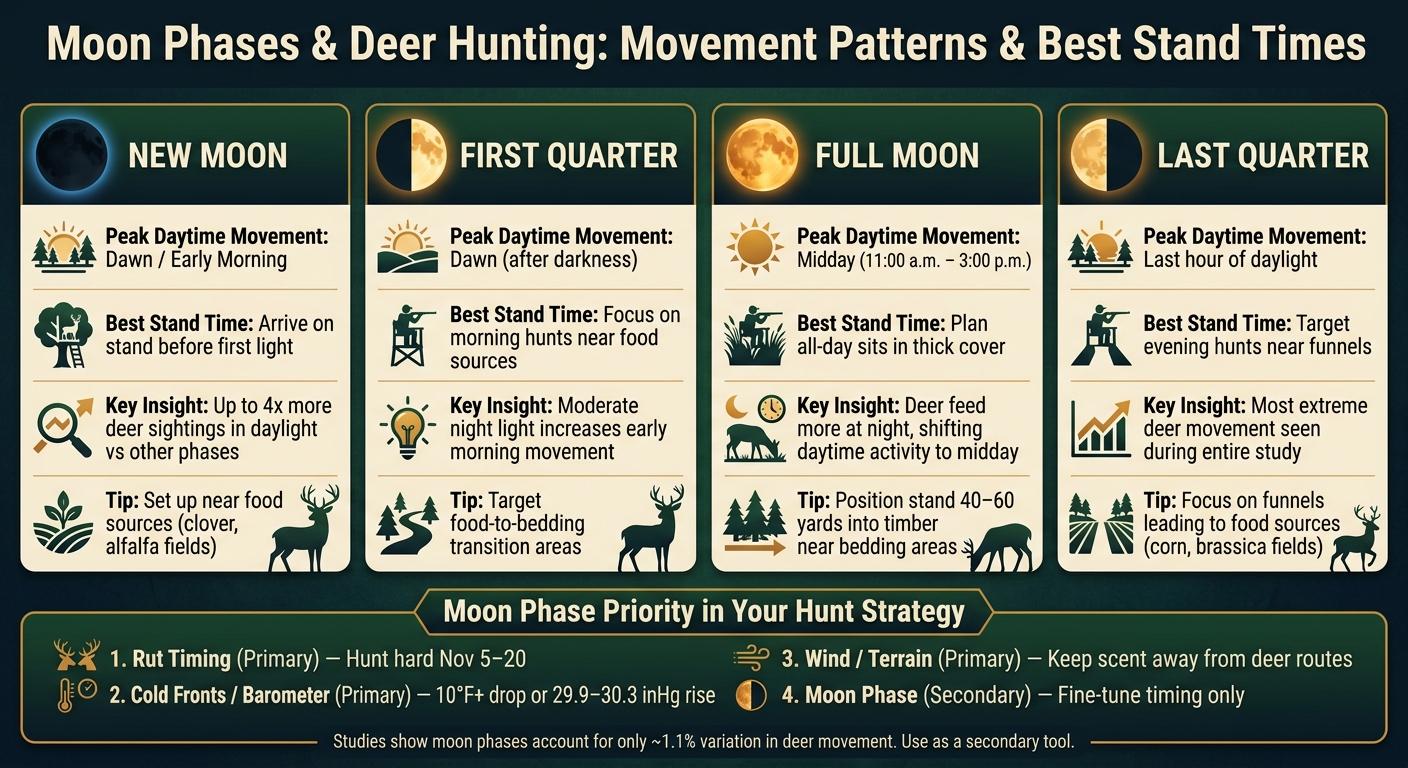
Moon Phases & Deer Hunting: Movement Patterns & Best Stand Times
The 4 Main Moon Phases at a Glance
Moon phases play a key role in determining nighttime light levels, which directly influence deer feeding and movement patterns. Here’s how each phase impacts deer activity:
- New Moon: With near-total darkness, deer are most active in the early daylight hours.
- Full Moon: Bright nights encourage nocturnal feeding, pushing daytime activity to the middle of the day.
- First Quarter: Moderate night light leads to increased movement during early mornings.
- Last Quarter: Diminishing night light prompts deer to move more during the final hours of daylight.
These light-driven behaviors help hunters plan the best times to be in the field, as detailed in the movement patterns below.
Deer Movement Patterns by Moon Phase
Although moon phases influence deer movement, the effects are subtle – studies show they account for only about a 1.1% variation in movement patterns. Still, understanding these patterns can give hunters an edge. Here’s a breakdown of typical movement trends and effective strategies for each phase:
| Moon Phase | Peak Daytime Movement | Best Stand Time |
|---|---|---|
| New Moon | Dawn / Early Morning | Arrive on stand before first light |
| First Quarter | Dawn (after darkness) | Focus on morning hunts near food sources |
| Full Moon | Midday (11:00 a.m. – 3:00 p.m.) | Plan all-day sits in thick cover |
| Last Quarter | Last hour of daylight | Target evening hunts near funnels |
Research supports these trends. For example, hunter surveys show up to four times more deer sightings in daylight during new moons. The deep darkness of the new moon concentrates deer activity into the early morning hours when light returns.
During a full moon, the abundance of night light causes deer to feed more after dark, shifting their movement to midday hours. As Marcus Lashley from North Carolina State University explains:
"According to our data, they move less on average at night during a full moon and more during the middle of the day."
This midday window – roughly 11:00 a.m. to 2:30 p.m. – has become a prime time for harvesting mature bucks. Many hunters book a hunt during these specific lunar windows to maximize their chances.
The last quarter phase is also noteworthy. Lashley’s research highlights:
"If you are going to hunt the last hour of the day anytime this season, you should do it on the last quarter because that was the most extreme deer movement we saw during the whole study."
Using Moon Position to Time Your Hunt
In addition to moon phases, the moon’s position in the sky can further refine hunt timing. Many hunters rely on solunar theory, which tracks the moon’s overhead and underfoot positions (major periods) as well as its rise and set (minor periods). While these windows can temporarily boost activity, their impact is relatively small. For example, studies show only a 7-minute delay in buck bedding when the moon is near the horizon.
To make the most of solunar data, treat it as a secondary tool, complementing other factors like weather conditions and feeding patterns. Combining these insights can help you fine-tune your hunting strategy.
Hunting Kentucky Whitetails by Moon Phase
Early Season Tactics
In Kentucky’s early hunting season, moon phases play a key role in predicting deer movement. On private land with minimal hunting pressure, deer tend to stick to their natural routines, making their behavior easier to track.
During a new moon, deer are most active at dawn. Set up near food sources like clover or alfalfa fields, as deer compensate for the darker nights by moving more at first light. Marcus Lashley from North Carolina State University explains:
"We saw a large peak of movement at daylight during the new moon, and below average activity the rest of the day."
On full moon mornings, deer often finish feeding before legal shooting hours. Instead of open field edges, position your stand 40–60 yards into the timber along trails leading to bedding areas. If you’re hunting with Whitetail Hunting Kentucky, their Velvet Bow Hunt package ($3,750 for 5 days/6 nights) offers guided hunts in Northeastern Kentucky, where expert guides can help you choose stands based on the current moon phase.
As the season transitions into the rut, deer behavior changes, requiring hunters to adapt their strategies.
Rut Season and Full Moon Tactics
The rut, which peaks in early-to-mid November in Kentucky, brings a noticeable shift in deer activity. A full moon during this period pushes bucks to move more at night, leaving their daytime activity concentrated between 10:00 a.m. and 2:30 p.m.
To adjust, focus on areas with natural cover – saddles, brushy ditches, or oak flats – where bucks feel safer during daylight hours. Michael Hanback, host of Big Deer TV, shares his experience:
"This was the fifth whitetail that scores more than 160 inches that I have shot between noon and 2:30 pm during a full moon."
Set up on the downwind side of doe bedding areas and stay patient during the midday hours. Whitetail Hunting Kentucky’s Rifle Season package ($4,500 for 5 days/6 nights) aligns perfectly with the peak rut, combining moon phase strategies with local expertise to place hunters in prime buck travel corridors.
Late Season Tips
As the hunting season winds down, weather and hunting pressure often outweigh moon phases in influencing deer movement. Late-season deer are wary, and factors like a 10–15°F temperature drop or rising barometric pressure (29.9 to 30.3) can spur activity more effectively than moon phases. Dr. Robert Sheppard, a seasoned deer-hunting instructor, notes:
"I learned that temperature had a greater bearing on deer sightings than the moon phase did… a bright moon phase and warm weather meant hunters wouldn’t see many deer at the end of the season."
Moon phases, however, still provide useful guidance. During the last-quarter moon, focus on the final hour of daylight near secluded funnels leading to food sources like standing corn or brassica fields. On a full moon, midday sits near bedding thickets can be productive. And when a cold front hits during a full moon, Mark Drury of Drury Outdoors emphasizes:
"If a cold front sweeps through your hunting area when the moon is full, deer activity will be phenomenal."
In Kentucky’s eastern hill country, be mindful of morning thermals that can carry your scent into bedding areas. A successful late-season strategy combines moon phases with weather patterns and terrain awareness for the best results.
Combining Moon Phases with Other Hunting Factors
How Weather and Rut Timing Affect Deer Activity
Relying solely on moon phases to predict deer movement can be misleading. Factors like weather changes and rut timing are far more reliable indicators of daytime deer activity. For instance, a cold front that drops temperatures by 10–15°F or a quick rise in barometric pressure to levels between 29.9–30.3 inHg often prompts more consistent deer movement than any moon phase.
Whitetail behavior expert Charlie Alsheimer explains it well:
"Weather, barometric pressure, light intensity, both sun and moon… Although each can trigger or suppress deer activity on its own, it’s when they work together that they have the most noticeable effect."
The same principle applies to the rut. In states like Kentucky, where peak breeding occurs between November 5–20, the rut is driven by photoperiod – essentially the length of daylight – not moon phases. This means hunters should focus their efforts on these prime dates, regardless of what the moon is doing.
Mastering how weather and the rut influence deer behavior lays the groundwork for effectively using wind and terrain to your advantage.
Wind Direction and Terrain Selection
Wind direction is a game-changer in deer hunting. Even if the moon phase aligns perfectly, it won’t matter if your scent drifts into bedding areas. For example, in Kentucky’s eastern hill country, morning thermals tend to lift your scent toward higher ground (potentially bedding areas), while evening thermals cause it to settle. Understanding these patterns is far more useful than relying on solunar tables.
Terrain features like saddles, benches, and funnels are critical tools for positioning yourself downwind of travel routes. On heavily hunted land, deer often become nocturnal no matter the moon phase. In such cases, moving deeper – 600 yards or more – into dense, secure cover can be the key to success. Timing your hunt around wind and terrain beats relying on solunar periods every time.
How to Prioritize These Factors for Kentucky Hunts
To refine your hunting strategy, it’s essential to rank these factors by importance. Here’s how to prioritize the key elements for a successful hunt in Kentucky:
| Factor | Priority | How to Use It |
|---|---|---|
| Rut Timing | Primary | Focus on hunting hard from November 5–20, regardless of the moon phase. |
| Cold Fronts / Barometer | Primary | Plan hunts immediately after a 10°F+ temperature drop or when barometric pressure rises to 29.9–30.3 inHg. |
| Wind / Terrain | Primary | Always position yourself so your scent stays away from deer travel routes. |
| Moon Phase | Secondary | Use moon phases to fine-tune timing – midday sits during full moons, dawn hunts during new moons. |
While moon phases can help adjust the timing of your hunt, they should only be considered after weather, wind, and rut conditions. If you’re already planning to hunt during optimal weather and wind, a favorable moon phase is just a nice bonus. The best scenario combines a full moon, a cold front, and falling temperatures during Kentucky’s peak rut. When these factors align, staying in your stand all day can yield excellent results.
For those seeking a guided experience, Whitetail Hunting Kentucky’s Late Muzzleloader package ($2,450 for 4 days/5 nights) offers expert guidance. These hunts are tailored for late-season opportunities, where guides analyze local weather, terrain, and moon data to place you in the ideal spot at the perfect time.
Conclusion: Putting Moon Phase Knowledge to Work
Moon phases have a small influence on deer behavior. Dr. Bronson Strickland, Former Co-Director of the Mississippi State University Deer Lab, analyzed nearly a million data points from collared bucks and found only a 1.1% difference in yards walked per hour across various moon conditions. So while it’s worth considering, it’s not a game-changer for your hunting strategy.
Instead, focus on factors that have a bigger impact. Key elements like weather, wind, and rut timing should drive your approach. For example, a cold front that drops temperatures by 10–15°F, barometric pressure rising to 29.9–30.3 inHg, and peak rut dates – like November 5–20 in Kentucky – are far more reliable indicators.
Moon phases, however, can help fine-tune your positioning. During full moons, hunting near bedding areas can be effective, while new moons are ideal for targeting food-to-bedding transitions at dawn and dusk. On heavily pressured public land, human activity often overshadows any lunar effects, making low-pressure areas the best places to see noticeable results from moon phase strategies. By blending moon phase insights with proven weather and terrain tactics, you can craft a well-rounded hunting plan.
For those looking to put these strategies into action, Whitetail Hunting Kentucky offers guided hunts on managed, low-pressure land in Northeastern Kentucky. These environments allow lunar and weather patterns to be more consistent and predictable. Packages include the Archery/Crossbow Hunt for $2,850 (5 days/6 nights) and the Rifle Season Hunt for $4,500 (5 days/6 nights) during peak rut. Experienced guides adapt daily strategies using current conditions, trail camera data, and local deer activity, ensuring moon phase insights enhance, rather than dominate, your overall approach.
FAQs
Do moon phases really change deer movement enough to matter?
Research has long debunked the idea that moon phases significantly influence deer movement. Studies, including those conducted by Mississippi State University, have uncovered no strong connection between lunar phases, moon positioning, or solunar activity and the movement patterns of bucks. Instead, factors like the rut, weather conditions, and hunting pressure play a far greater role in determining deer activity than anything related to the moon.
How do I use moonrise and moon overhead times to plan a hunt?
Many hunters rely on solunar theory to plan their hunts, even though its effect on deer movement hasn’t been scientifically confirmed. Solunar tables point to major activity periods when the moon is directly overhead or underfoot, as well as minor periods during moonrise and moonset. These can be useful for fine-tuning your hunting schedule, particularly when they align with dawn or dusk. That said, it’s more important to focus on key factors like wind direction, temperature changes, and established deer travel patterns to increase your chances of success.
What matters more than the moon when hunting Kentucky whitetails?
When it comes to hunting Kentucky whitetails, there are factors far more influential than the moon. The most important drivers of deer movement include the photoperiod (the amount of daylight), the breeding rut, shifts in temperature, weather fronts, and wind direction. Additionally, heavy hunting pressure often forces deer into nocturnal habits, regardless of the moon phase. While the moon can play a role in refining your approach, prioritizing weather conditions and rut timing will yield better results.